
In the context of the rapidly spreading Fourth Industrial Revolution, Dak Lak province has identified the need to strengthen the “three-party” linkage model: State agencies - Research Institutes/Universities - Enterprises, in order to create momentum for innovation, realize the need for coordination, and bring the results of scientific and technological research into practical production and business in the province.
Recently, the Department of Science and Technology organized a signing ceremony for a Memorandum of Understanding (MOU) to pilot the “three-party” linkage model. At this ceremony, the parties agreed to cooperate in implementing key science and technology tasks to enhance the value of the province's distinctive product chain. Two tasks were mentioned: Applying technological advancements to diversify products from Dak Lak durian, with the cooperation of the Department of Science and Technology, Ho Chi Minh City University of Industry and Trade, and related units.
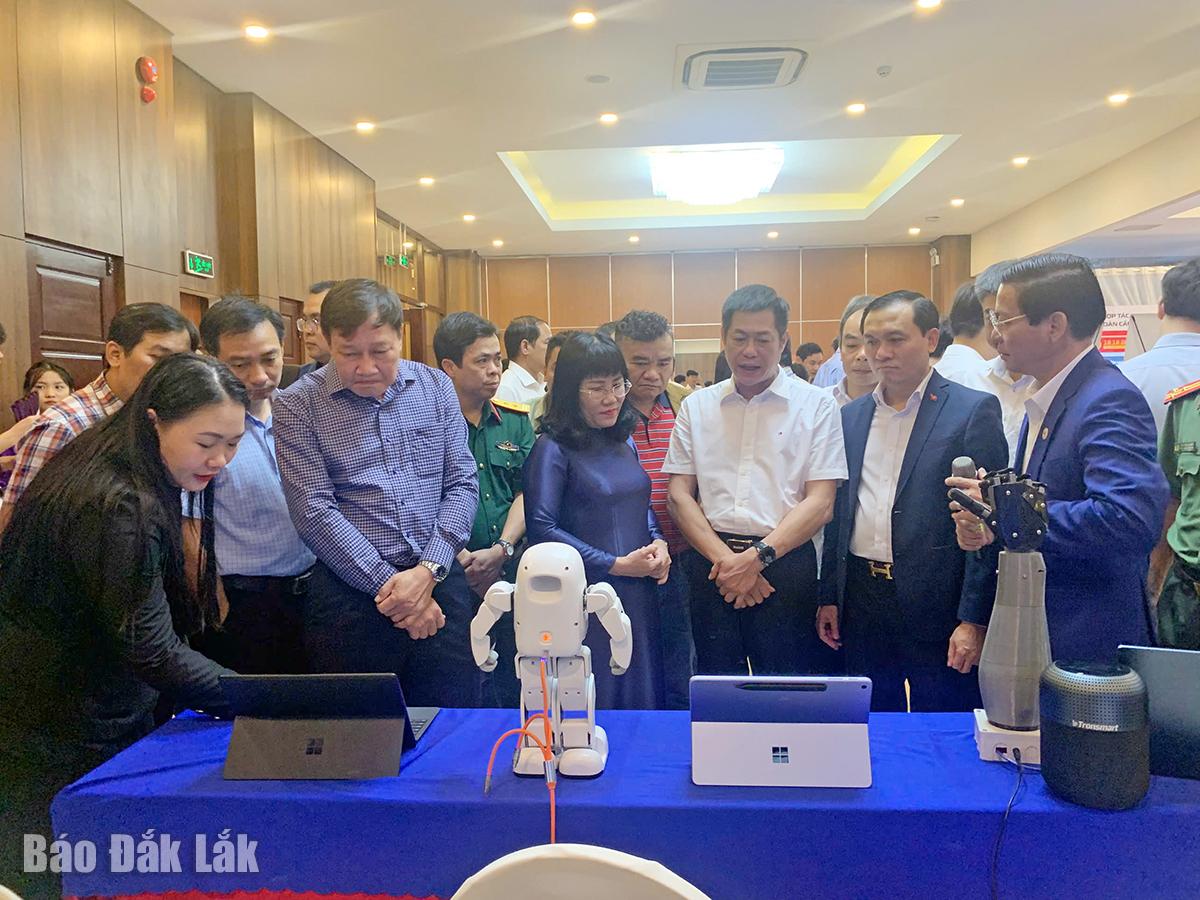 |
| Science and technology enterprises introducing digital technology products to provincial leaders, departments, and delegates |
From a business perspective, Mr. Tran Van Vu, Chairman and CEO of Vietnam Organic Nopal Joint Stock Company, believes that the “three-party” cooperation model has fostered confidence, encouraging businesses to boldly invest in science and technology.
Furthermore, Dak Lak province has established cooperation with institutes/universities and scientific organizations inside and outside the province, linking with technology businesses in the area; focusing on investing in technology, building data centers and shared digital platforms. According to the Department of Science and Technology, the unit has held working sessions with 11 institutes/universities and 4 businesses to agree on strengthening cooperation in research and technology transfer, supporting innovation businesses, promoting training of science and technology personnel, and coordinating the application of new technologies in production.
These developments show that institutes and universities are becoming the core of the “State - University - Business” linkage chain. Scientific and technological research activities have been closely following the practical needs of the locality, with many high-tech agricultural models being applied to reduce costs, improve quality, and increase the value of agricultural products.
Some businesses have applied IoT devices and drones to agricultural cultivation, advanced materials to electricity production, and are planning to apply digital mirroring technology, virtual reality, and increase virtual reality to the tourism sector, etc.
By the end of 2025, Dak Lak province had 33 scientific and technological organizations, mainly operating in the fields of social sciences and humanities; and agricultural science. Regarding human resources, the province had 4,507 people working in science and technology organizations, including 4 professors, 24 associate professors, 189 PhDs, 1,003 masters, and 2,300 university graduates.
Mr. Bui Thanh Toan, Member of the Provincial Party Standing Committee and Director of the Department of Science and Technology, said that in the coming time, the province will continue to focus resources on projects with a ripple effect, encourage businesses to invest in high technology, build a high-quality workforce, and promote science and technology and innovation based on the close linkage of the “three stakeholders”, as the core to form an innovation ecosystem.
To ensure this linkage is truly sustainable, Dak Lak province will continue to focus on building and submitting to the Provincial People's Council for promulgating a Resolution on specific mechanisms and policies of the province to promote science and technology, innovation and digital transformation (investment incentives, business support, risk acceptance, etc.); give out specific policies to attract, recruit, reward, and utilize digital transformation personnel working in State agencies, ensuring sufficient quantity and quality, and suitability to the province's specific characteristics; establish mechanisms and policies for awarding exceptional achievements and incorporate the results of digital transformation at the commune level (measured by digital economic efficiency) into the criteria for evaluating and ranking leaders and managers annually, etc.
Translated by TRINH THUY


