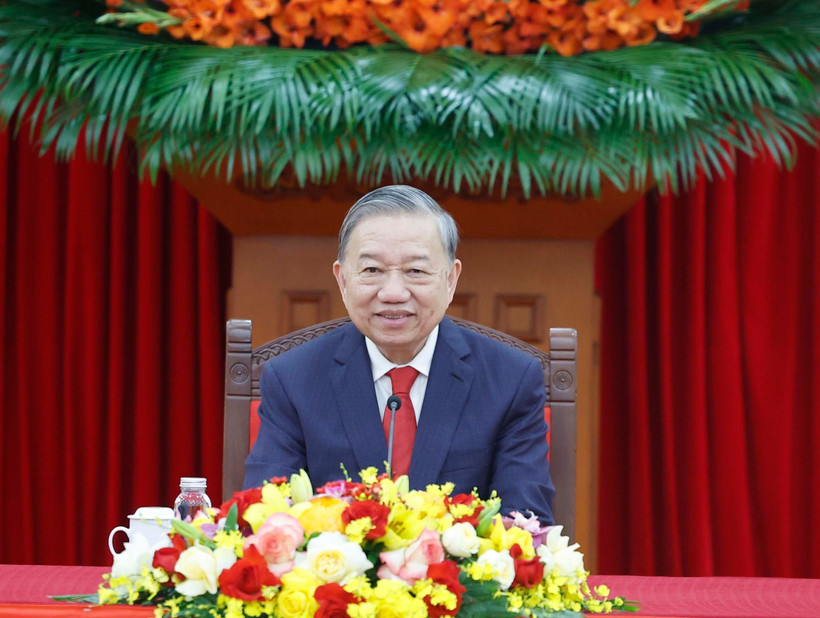
The 14th National Congress of the Communist Party marks a milestone of special political significance, shaping the strategic vision for the national new development phase. For the entrepreneur community, the outcomes of the Congress carry not only profound political meaning but also reinforce confidence, motivation and expectations for a stable, transparent and sustainable development environment amid increasingly deep international integration.
Many businesses hold that, amid ongoing and increasingly unpredictable global economic fluctuations, the consistency of the Party’s development orientation serves as a vital foundation enabling enterprises to confidently shape long-term strategies, step up investment, expand production and enhance competitiveness. Notably, the 14th National Congress’s affirmation of the private economic sector as "the most important driving force" of the economy, alongside the state sector’s leading role in strategic regulation has generated strong confidence and optimism across the entrepreneur community.
 |
| Outcomes of the 14th National Party Congress have fostered confidence, momentum and expectations for a stable development environment. In the photo: Workers at a garment enterprise in Tuy Hoa Ward. |
According to Mr. Huynh Van Dung, Chairman of the Provincial Business Association, the entrepreneur community’s greatest expectation at present is that the orientations and policy decisions adopted at the 14th National Congress will soon be comprehensively institutionalised and implemented with determination through a streamlined, effective and efficient administrative apparatus guided by a strong service-oriented mindset. Enterprises hope for substantive administrative reform that cuts unnecessary red tape, addresses the “strong leadership at the top but weak implementation at the grassroots” phenomenon as well as upholds the principle of not criminalising economic and civil relations, thereby fostering confidence for entrepreneurs to invest, innovate and create.
Alongside institutional reform, many businesses are also calling for more concrete policies to promote digital transformation and the development of a green and circular economy. Support mechanisms for research and development, incentives for innovation, as well as the early completion of a regulatory sandbox framework for new business models are expected to create additional room for enterprise growth.
According to Mr. Le Van Hong, Director of Ba Hai JSC. (Hoa Hiep Industrial Park), the continued improvement of institutions, accelerated administrative procedure reform, and the development of a digital government, digital economy and digital society are seen as key levers enabling businesses to reduce costs, improve governance efficiency and enhance competitiveness. These are critical conditions for nurturing enterprises with sufficient capacity to lead key sectors and integrate more deeply into regional and global value chains.
Drawing on operational realities, businesses are calling for more concrete strategies to promote digital transformation and the green economy, particularly through research and development support funds, tax incentives, and the early completion of regulatory sandbox frameworks for new business models. Support for the effective implementation of ESG standards (measuring environmental, social and corporate governance factors) is seen as a “passport” to ensure Vietnamese goods are not excluded from international markets.
Finally, breakthroughs in strategic infrastructure such as high-speed railways and digital infrastructure are expected to help reduce currently high logistics costs, while being combined with the training of high-quality human resources in key sectors such as semiconductors and clean energy. Together, these factors are seen as providing the “special fuel” needed to propel the economy forward in the new era.
According to Mr. Hoang Danh Huu, CEO of EDE Farm Trading and Services Co., Ltd., the principle that “the private sector is the most important driving force of the economy” needs to be translated into more flexible and effective public-private partnership mechanisms. Businesses expect the State to continue unlocking resources related to land and infrastructure, thereby enabling the private sector to participate more deeply in development projects. For localities with strong potential such as Dak Lak, the completion of strategic transport routes will increasingly open up opportunities to shift from exporting raw materials to deeper processing, logistics development, and deeper integration into global value chains. What enterprises ultimately seek is decisive, transparent and consistent implementation; therefore, opportunities can be turned into genuine drivers of development.
It can be affirmed that the 14th National Congress has generated fresh momentum and renewed confidence within the entrepreneur community. When the Party’s sound guidelines are promptly institutionalised and effectively implemented, that confidence will be translated into concrete action, providing strong impetus for enterprises to make breakthroughs and contribute more substantially to economic growth and the country’s sustainable development in the new phase.
Translated by HAI LOAN