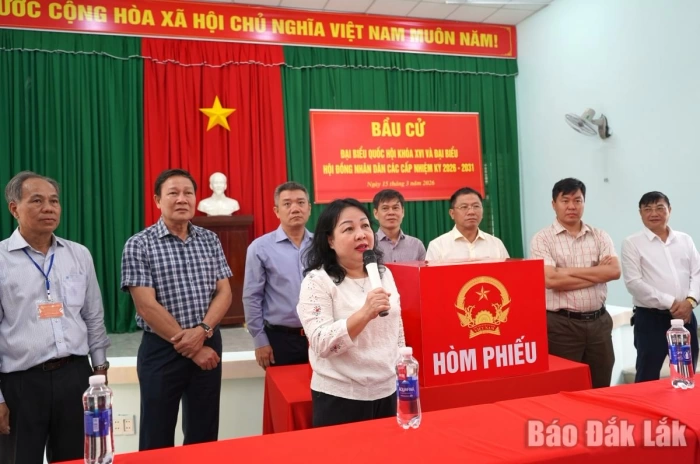
Identifying communication work as a key task, member agencies of the Election Information and Communication Subcommittee of Dak Lak province have recently followed the plan and implemented a wide range of coordinated communication activities.
The Provincial Party Committee’s Commission for Information, Education and Mass Mobilisation advised the organisation of conferences to study and disseminate information on the election at 142 online points, with more than 9,300 participants. It also directed agencies and localities to publish more than 1,800 news items and articles related to the election on social media platforms such as Facebook, Zalo and TikTok.
 |
| Voters in residential group 7, Tan Lap ward, reviewing the voter list and the list of candidates for the National Assembly and People’s Councils at all levels. |
Particular attention has been given to visual communication and mobile information campaigns, especially in remote areas as well as ethnic minority communities. Mr. Tran Hong Tien, Director of the Department of Culture, Sports and Tourism, said: “We have produced numerous video clips and information bulletins for grassroots dissemination and directed specialised units to develop plans for visual activities before, during and after the election period. Units under the department have also actively organised mobile loudspeaker teams using bilingual Vietnamese - Ede broadcasts to bring information directly to villages and hamlets. Our guiding principle is to implement activities in line with the plan and ensure information reaches people at the grassroots level as effectively as possible”.
The Department of Justice successfully organised the online contest “Learning about Election Law”, attracting 48,729 registered participants with 66,129 entries. The election management software system has been successfully connected via the specialised data transmission network to 102 communes and wards across the province.
Dak Lak Newspaper and Radio - Television have published hundreds of news reports, infographics and in-depth features. Communication in ethnic minority languages has been prioritised, with more than 100 news bulletins, reports and programmes in Ede, M’nong and Cham broadcast regularly on radio, television and digital platforms to meet the information needs of ethnic minority communities.
Mass organisations at different levels, including the Women’s Union, the Provincial Youth Union, the Farmers’ Union and the Provincial Confederation of Labour, have actively integrated election-related content into meetings and cultural activities. To date, all commune-level Women’s Union branches have completed dissemination of election information at the grassroots level. Youth union members have also published more than 200 news items as well as articles while launching campaigns to display national flags along major roads. The grassroots broadcasting system has continuously updated information on voters’ rights and responsibilities.
 |
| At Dak Lak Museum, the Department of Culture, Sports and Tourism organising a thematic exhibition titled “Dak Lak and the National Assembly - Steadfast confidence, shared aspirations” to welcome the election. |
Comrade Vu Van Hung, Secretary of the Party Committee and Chairman of the People’s Council of Tan Lap ward, said that to ensure election information truly reaches every resident, the ward has disseminated information through Party cell and neighbourhood meetings. It has also photocopied the list and brief biographies of candidates for the National Assembly and the provincial and ward-level People’s Councils and delivered them to each household. This allows residents time to review the information carefully and take a more proactive role in selecting deserving representatives when casting their ballots.
As election day approaches, the requirements for accuracy, timeliness and information coverage have become increasingly important. Comrade Dinh Thi Thu Thanh, Member of the Provincial Party Standing Committee, Head of the Provincial Party Committee’s Commission for Information, Education and Mass Mobilisation and Head of the Election Information and Communication Subcommittee, emphasised: “The tasks ahead remain substantial, particularly during this final stage. We must ensure that all people perceive the election as truly a nationwide festival. Agencies must diversify communication products, not only through traditional channels but also by maximising digital platforms. Special attention must be given to communication in ethnic minority languages so that residents in remote areas can fully understand the biographies alongside action programmes of candidates and clearly grasp their rights and responsibilities”.
Translated by KHUONG THAO