From digitising land databases to deploying IoT sensors and drones in production, agriculture in Dak Lak is gradually shifting from experience-based farming to data-driven management.
Reducing production risks
The Department of Science and Technology (S&T) has recently organised the handover of a national-level project titled “Building a digital database of agricultural production land in Phu Yen province (now eastern Dak Lak province)”, led by the Institute of Soil and Fertiliser Research, with Dr. Luong Duc Toan as project director.
The project has produced not only scientific reports but, more importantly, a digital database and an online management platform (WebGIS) at https://csdldatsxnndaklak.com.vn, allowing users to update as well as retrieve information on agricultural land across 34 communes in eastern Dak Lak.
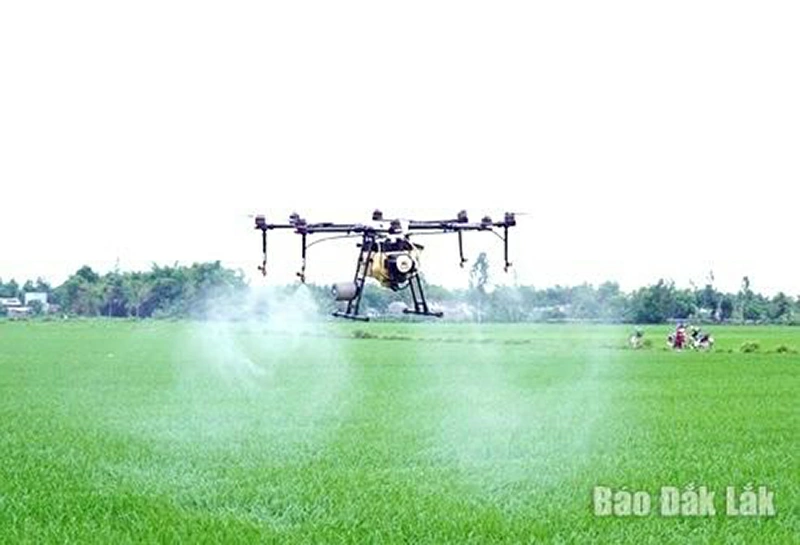 |
| Farmers in Binh Kien ward using drones to spray pesticides. |
According to the S&T Department, digitising land data enables a transition from manual to data-driven management, improving planning efficiency, reducing production risks, as well as enhancing climate resilience.
In addition, Department has actively coordinated with scientists, research institutes, and universities to implement numerous S&T projects related to agriculture.
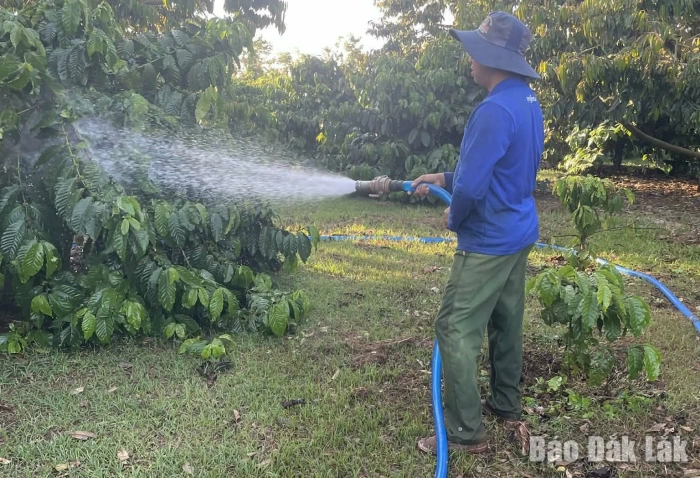
In durian-growing areas, instead of irrigating based on intuition, many farmers have installed smart moisture sensors. Mr. Cao Nguyen Lam, a farmer in Ea Ba commune and a pioneer in applying this technology, said: “With accurate data on moisture levels along with nutrient requirements transmitted to my phone, I can remotely control the drip irrigation system”. This model helps save nearly 30% of water and electricity while significantly reducing fertiliser loss and supporting more sustainable production.
According to statistics from Department of Agriculture and Environment, more than 30% of replanted fruit tree and industrial crop areas have adopted water-saving irrigation alongside smart monitoring technologies, contributing to optimised water resource use.
Gradually building a technology ecosystem
Transformation of agriculture in Dak Lak is also marked by the use of drones. Application for spraying crop protection chemicals and fertilisers with high precision helps reduce labour, save time, as well as limit direct exposure to chemicals. More importantly, precise control of dosage and coverage helps reduce chemical residues and meet stringent market requirements.
Simultaneously, application of QR codes and electronic production logs is enhancing transparency of agricultural products. Each batch is fully recorded with cultivation along with harvesting data, facilitating traceability during distribution.
To promote digital transformation in agriculture, Dak Lak has been implementing various support policies, prioritising resources for high-tech application models while encouraging cooperatives together with enterprises to invest in equipment and digital infrastructure. Notably, pilot projects applying AI for early pest detection alongside yield forecasting are opening up prospects for a green, clean, and safe agricultural sector.
Mr. Nguyen Van Dong, Director of Hoa Phong Agricultural Service and Business Cooperative (Tay Hoa commune), said: “When mechanisation as well as digital technology are applied synchronously, production efficiency improves markedly. Members’ profit increases by 8 - 10 million VND per hectare compared to traditional farming, while products gain easier access to higher-standard markets”.
Translated by KHUONG THAO