The UAV technology is particularly effective in addressing challenges faced by ground infrastructure, especially in densely populated urban areas and remote regions. Smart aerial devices also enable real-time data collection, improving governance, decision-making and digital transformation across industries.
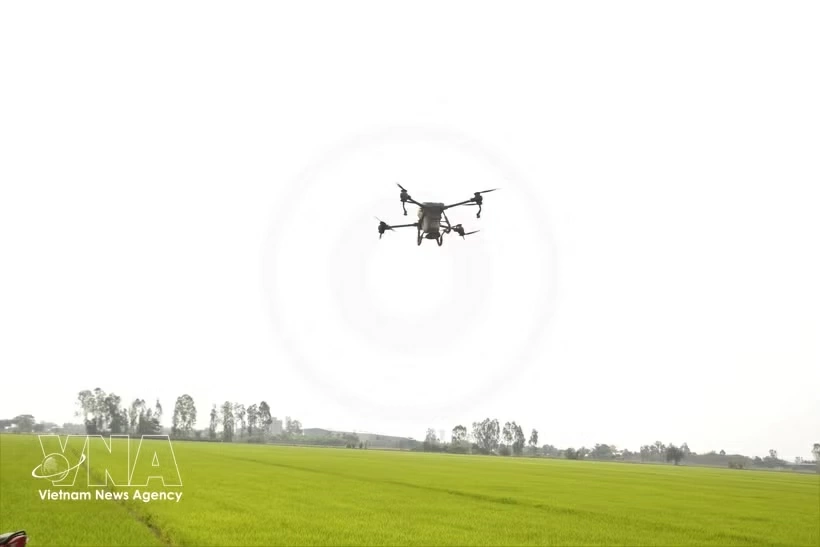 |
| A drone sprays fertiliser over rice fields. (Photo: VNA) |
Vietnam’s low-altitude economy is emerging as a promising growth driver, underpinned by technology and data, as unmanned aerial vehicles (UAVs) are among the six prioritised strategic technology products and some supporting technologies for this economy are also named among the 11 groups of national strategic technologies.
The low-altitude economy refers to economic activities conducted in airspace below 1,000 metres, involving UAVs, small aircraft and helicopters, alongside control systems and air traffic management. It represents a comprehensive ecosystem of equipment, infrastructure, services and applications supporting production and daily life.
The model is gaining traction across sectors such as logistics, agriculture, surveying, environmental monitoring, search and rescue, and emergency health care. At scale, these applications can help enhance productivity, reduce costs, shorten processing time, expand service supply chains, and create new industries and jobs.
The UAV technology is particularly effective in addressing challenges faced by ground infrastructure, especially in densely populated urban areas and remote regions. Smart aerial devices also enable real-time data collection, improving governance, decision-making and digital transformation across industries.
Hoang Anh Tu, Deputy Director of the Department of Science, Engineering and Technology under the Ministry of Science and Technology (MoST), said a national strategy on UAV development and application through 2030, with a vision to 2045, has been submitted to the Politburo. Many domestic enterprises have already begun testing, producing and developing UAVs.
The strategy identifies UAV development as essential for mastering core technologies and building a new high-tech industry. UAVs are expected to transform low-altitude transport, with development oriented towards dual-use applications serving both civilian and defence – security purposes.
Vietnam aims to gradually achieve technological autonomy by researching and mastering core components such as flight controllers, edge AI chips, data transmission systems and operational software. The State will play a leading role in shaping demand and piloting applications while enterprises are expected to drive innovation and enhance global competitiveness.
A national UAV application programme is being designed, focusing on key areas including smart agriculture, logistics, smart cities, energy infrastructure, and defence – security. Plans are also underway to establish three national UAV testing zones in major industrial, agricultural and urban areas for assessment before wider deployment.
The MoST has stressed the importance of building a legal framework through national standards and technical regulations governing safety, operations and low-altitude airspace management, alongside requirements on data security and remote identification.
“Sandbox” mechanisms are also being developed to allow businesses to test new products and services such as aerial delivery and flying taxis in controlled environments. A national UAV testing and certification centre is planned to ensure product quality meets international standards.
From pilot models to policy completion
The northern mountainous province of Dien Bien has been selected as the first locality to carry out a scheme for controlled pilotting of the low-altitude economy development using UAVs.
Deputy Minister of Science and Technology Bui Hoang Phuong said the sector is new, interdisciplinary and holds significant growth potential. The selection of Dien Bien reflects is not only based on its mountainous terrain and fragmented geography but also aims to create a reference model for other localities, he added.
He noted that UAV technology has already been applied in many places, so the focus should be on building practical application models to evaluate efficiency. Implementation must be large-scale, linked to real-world challenges such as goods transportation, and combined with data collection to support production, business and governance.
Experts said that this approach is aligned with Resolution No. 57, which emphasises practical outcomes, controlled risk-taking and pilot models to foster innovation. Pilot programmes at the local level are expected to provide valuable data for developing standards, technical regulations and a comprehensive legal framework for UAV production, testing and operation in the future.
VNA