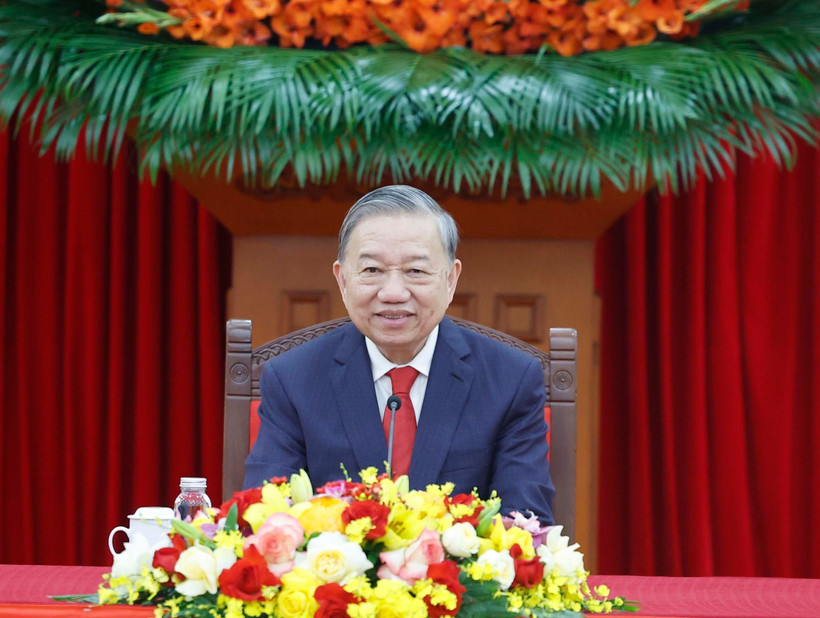
The successful conclusion of the 14th National Congress of the Party has left a strong mark in terms of vision, policymaking and aspirations for national development in the new period.
The documents and resolutions adopted at the Congress not only clearly define development goals through 2030, with a vision to 2045, but also create new space for harnessing the role of social forces, including the intellectual community.
Throughout successive Party Congresses, the Party and the State have consistently affirmed that building a strong intellectual contingent is a strategic task. The Resolution of the 14th National Congress not only opens space for aspirations but also places upon the intellectual community of Dak Lak the mission of becoming the “pulling force” that helps steer the local economic engine toward deeper integration and higher value chains.
 |
| The intellectual workforce of the provincial Department of Science and Technology operating smart urban services |
Dak Lak has long been regarded as a “hub” for billion-dollar agricultural products such as coffee, durian and pepper. However, the value of each agricultural product can hardly achieve a breakthrough without sufficient intellectual input. In recent years, although the province’s intellectual community has actively contributed to the development of green and circular economic models, the results have remained below expectations.
According to Dr. Vo Anh Khue, a lecturer at Mien Trung Industry And Trade College, the intellectual community in Dak Lak currently holds significant advantages thanks to the presence of universities and leading research institutes in agriculture and forestry. However, the gap between research outcomes and practical production still needs to be narrowed. In particular, greater efforts are required to promote high-tech agriculture, including the AI and IoT application in disease management and smart irrigation. Simultaneously, digital technologies should be leveraged to preserve and promote the cultural value of gong heritage, closely linked to sustainable tourism development.
 |
| Phu Yen University lecturers propagating Ma Do tea plants through tissue culture |
Sharing the same view, Mr. Nguyen Van Khoa, former Chairman of the Provincial Union of Science and Technology Associations, said that the new era of national advancement calls for a generation of intellectuals who are not only professionally competent but also driven by a strong sense of public service. The Resolution of the 14th National Party Congress underscores the importance of attracting and utilising talent, while establishing mechanisms to protect those who dare to think innovatively, act decisively and pursue breakthroughs. Therefore, Dak Lak’s intellectuals and scientists need to take a more proactive role in policy review and consultation, proposing evidence-based solutions to support provincial leaders in making decisions that are closely aligned with practical realities. Simultaneously, the province’s scientific and intellectual community should act as mentors for local startups, helping transform innovative ideas into commercially viable products.
Building on the orientations, mechanisms and policies set out in the Resolution of the 14th National Party Congress, Dak Lak’s development, advancement and deeper integration will depend largely on the driving force of its intellectuals and scientists as the provincial “locomotive”. With professionalism and dedication, the province’s intellectual and scientific community is expected to write a new chapter in its development, helping Dak Lak rise in stature and confidently enter the nation’s new era.
Translated by HAI LOAN