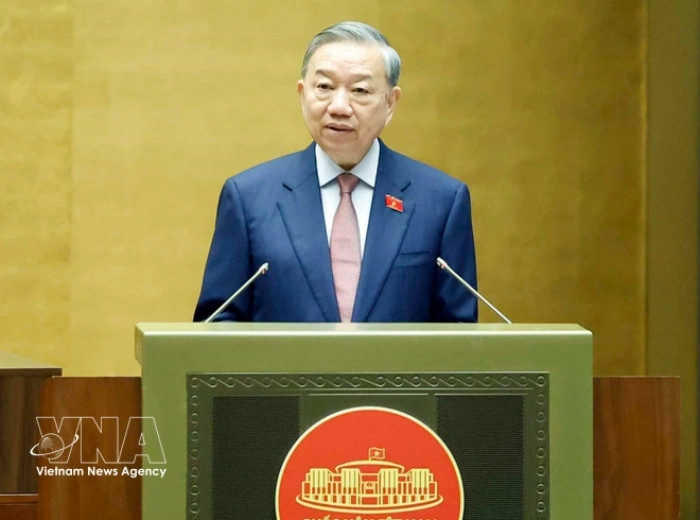
On April 6, alternate member of the Party Central Committee, Deputy Secretary of the Provincial Party Committee, PPC Chairman Do Huu Huy chaired a conference reviewing the second draft report on adjustments to Dak Lak Provincial Master Plan for 2021-2030, with a vision towards 2050. The meeting was connected online with localities province-wide.
The draft master plan for 2021-2030, with a vision towards 2050, is built on inherited development perspectives from earlier planning in Dak Lak and Phu Yen for the same period, ensuring consistency with national development orientation, the spirit of the 14th National Party Congress Resolution, the national 10-year socio-eco development strategy for 2021-2030, along with national, sectoral, and regional plans covering the South Central Coast together with Central Highlands for 2021-2030, with a vision towards 2050.
 |
| Delegates attending the meeting. |
By 2030, Dak Lak aims to become a green economic hub within the South Central Coast-Central Highlands region, while emerging as a distinctive destination attractive to both domestic and international visitors.
The province seeks to fully leverage advantages in geographic location and newly expanded development space, utilise natural resources alongside cultural identity effectively, and protect ecological environment in order to drive rapid, sustainable growth. Growth models will continue shifting toward science-technology, innovation, and digital transformation, while promoting green, circular, and marine economies, improving labour productivity, as well as proactively adapting to climate change.
Economic growth will be closely linked with social progress and equity, improving both material and spiritual living standards. Socio-eco development will go hand in hand with strengthening national defence, ensuring security, maintaining political stability, and safeguarding social order, thereby creating a solid foundation for rapid, sustainable development.
Looking ahead to 2050, Dak Lak targets becoming a well-developed province nationwide, with a modern economy, rational structure, and green, sustainable growth, etc.
Regarding spatial organisation, the draft proposes consolidating three development zones of former Dak Lak together with three zones of former Phu Yen into a new structure comprising five development corridors, six growth poles, and six development regions.
At the conference, delegates focused discussions on issues related to the number of development zones, inter-regional corridors, as well as several specific targets across sectors and fields.
 |
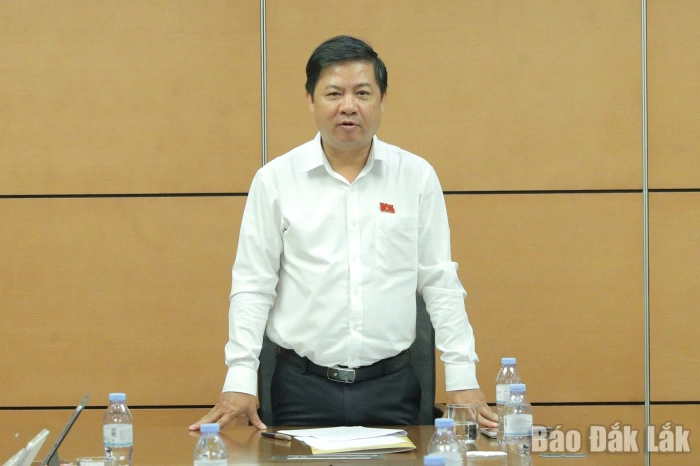
| Alternate member of the Party Central Committee, Deputy Secretary of the Provincial Party Committee and PPC Chairman Do Huu Huy addressing the conference. |
In his remarks, Chairman Do Huu Huy commended the consulting unit for preparing a comprehensive second mid-term report with strong inheritance and practical updates, stressing that this is a particularly important political task determining provincial development space. He emphasised that a key requirement is to clearly position Dak Lak on the national map, affirming its role as a sub-regional centre of the Central Highlands within the South Central Coast-Central Highlands economic region.
From a technical perspective, the master plan should formulate growth scenarios grounded in practical data alongside resource feasibility. Development space should follow an easy-to-remember model such as “one focal area - three growth poles - three corridors”, with the expanded Buon Ma Thuot urban area serving as a core for high-quality services and digital transformation. The report must also clearly highlight the provincial strongest advantages in becoming a regional centre for healthcare, education, alongside high-quality human resource training.
Translated by HAI LOAN