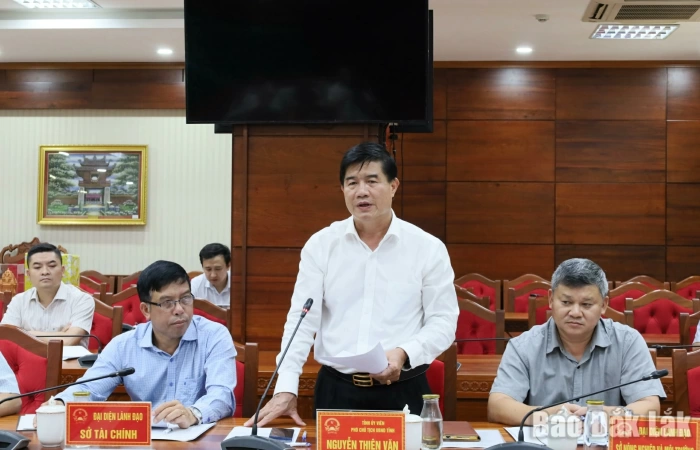
In the context of key indicators such as the Public Administration Reform Index (PAR INDEX) and the Satisfaction Index (SIPAS) continue falling short of expectations, Dak Lak province is resolutely seeking solutions to tackle “bottlenecks” in administrative procedures, digital transformation, as well as public service responsibility, determined to place the province into the top 10 localities nationwide in public services.
According to the provincial assessment, the administrative reform outcomes in the past period, while showing progress, are not yet sustainable. One notable concern is that the public SIPAS with the services of state administrative agencies has only reached 80.67%, significantly below the minimum requirement of 90%. Notably, over half of communes and wards have not reached the provincial average satisfaction level.
According to Mr. Nguyen Ba Vu, Deputy Head of Tax Department of Dak Lak province, one of the current bottlenecks is in technology alongside data infrastructure. The network connection between the tax authorities and the Provincial Public Administrative Service Center remains unsynchronised, causing difficulties for tax officials in accessing the system to support citizens combined with businesses.
 |
| Residents of Ea M'Droh commune guiding to carry out administrative procedures. |
Through the review, the province also frankly acknowledged that the responsibility among leaders of several agencies and units remains unclear. Using administrative reform results as a criterion to evaluate the level of task completion in some places was still superficial along with lacked decisiveness.
Administrative reform must be substantive
With the above situation, Dak Lak province aims to create strong changes in 2026. The province strives to bring the set of indicators for serving citizens and businesses into the top 10 localities nationwide; raise the SIPAS Index to at least 90%; as well as achieve a timely dossier processing rate exceeding 98% for applications; simultaneously, the time and cost of complying with administrative procedures will be reduced by 50% compared to 2024.
Central Party Committee member, Deputy Secretary of the Provincial Party Committee, PPC Chairman, comrade Do Huu Huy, emphasized: “Administrative reform must be substantive, not merely a reduction on paper without yielding practical results.” The Chairman requested that agencies, units, and localities in the province periodically build a ranking of administrative reform implementation results to promptly reward the top 5 agencies, units, together with localities with the highest rankings, while also strictly holding responsible the 5 agencies, units, and localities with the lowest rankings.
Comrade Do Huu Huy also requested the AI application promotion to shorten the processing time for applications alongside enhance transparency. Concurrently, he stressed the need to resolutely address harassment and corruption; while implementing personnel rotation in positions prone to corruption.
Furthermore, Dak Lak province continues to implement the “green channel” mechanism for key projects; review and simplify procedures related to businesses coupled with investors; shorten business registration time and publicly disclose procedures in the electronic environment, etc.
Ms. Hoang Thi Tam, Deputy Director of the Provincial Public Administration Service Center, proposed that the province needs to continue restructuring electronic processes, increasing the digitization of documents, reusing data, as well as perfecting the information system for resolving administrative procedures to ensure synchronous connection among levels, sectors, and the national database.
These solutions not only aim to improve the ranking of administrative reform indicators alongside competitiveness, but also demonstrate Dak Lak provincial determination to build a service-oriented administration, using the satisfaction of citizens and businesses as a core benchmark for evaluating effectiveness of the government apparatus.
Translated by TRINH THUY