Chairman of the Vietnam Tourism Association Vu The Binh said AI is opening up new opportunities, from analysing trends and personalising products to optimising promotion, revenue management and visitor flow forecasting, while shaping a smart tourism ecosystem.
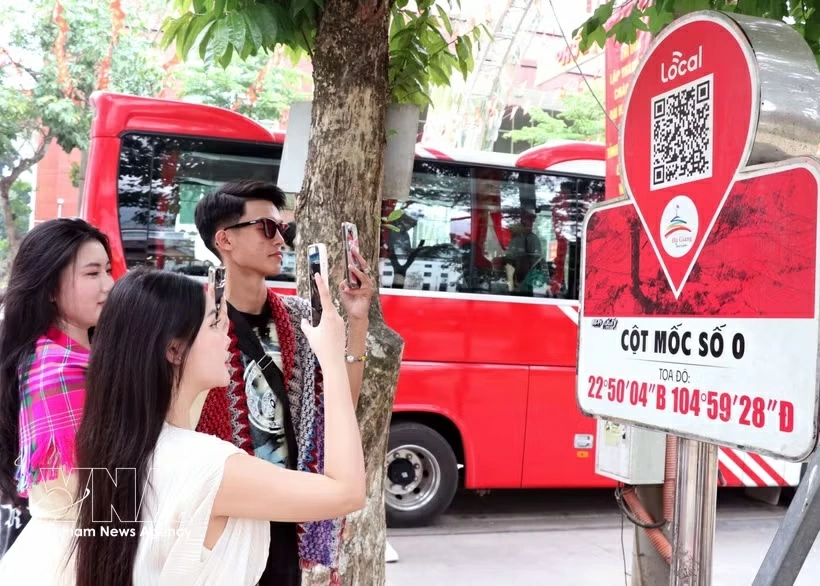 |
| Visitors scan a QR code on the Km0 Ha Giang marker to access tourism information. (Photo: VNA) |
In recent years, Vietnam’s tourism sector has posted steady gains in revenue and arrivals, but to boost competitiveness and ensure sustainable growth, the “smokeless industry” is shifting towards technology-driven, value-based development, with artificial intelligence (AI) emerging as a key catalyst for breakthroughs.
In practice, AI is increasingly embedded in how travellers plan, explore and experience their journeys, especially among younger tourists. A survey by Booking.com shows that 99% of Gen Z use AI before trips, with 42% receiving personalised recommendations and 40% researching destinations and timing. During their journeys, many continue using AI to translate languages, signs and menus (53%) or access information on heritage sites and museums (47%).
Chairman of the Vietnam Tourism Association Vu The Binh said AI is opening up new opportunities, from analysing trends and personalising products to optimising promotion, revenue management and visitor flow forecasting, while shaping a smart tourism ecosystem. If properly guided, AI can also help conserve resources, cut costs and emissions, and enhance sustainable destination management.
From a business perspective, Pham Ha, President and CEO of LuxGroup, noted that competition now lies between systems that are more efficient, agile and greener, with AI acting as a powerful productivity lever. When effectively applied, one employee can achieve the output of three to five, while also narrowing the gap between large and small firms and enabling wider access to global markets, laying the foundation for more inclusive growth.
To accelerate the adoption of AI, Big Data and the Internet of Things (IoT) in destination management and tourism promotion, Vietnam has rolled out a range of programmes, including the National Digital Transformation Programme and initiatives to develop smart tourism, positioning the sector as a spearhead of the economy.
Resolution No. 80-NQ/TW of the Politburo on cultural development also highlights the need to strengthen digital infrastructure and apply advanced technologies such as AI, Big Data and virtual technologies in cultural production, distribution and management, providing a key foundation for tourism to better leverage cultural resources in the digital environment.
In recent years, tourism businesses have stepped up the use of technology and data to optimise operations and enhance visitor experiences, with solutions such as virtual assistants, guiding robots, multilingual audio guides and real-time translation emerging. However, challenges remain, including fragmented data, uneven digital capacity, limited resources among small and medium-sized enterprises, and a shortage of skilled personnel combining tourism and technology expertise.
To address these bottlenecks, Deputy Director General of the Vietnam National Authority of Tourism Pham Van Thuy stressed the need for stronger coordination among the State, businesses, communities and international partners. He underscored that successful digital transformation depends on changes in mindset and action, urging tourism enterprises to proactively adopt new technologies, particularly AI, while investing in high-quality human resources capable of mastering them.
At the same time, data-driven tourism is gaining traction, with decisions on products, pricing and experiences increasingly based on behavioural data and AI forecasts. According to Dr .Nguyen Anh Tuan, Director of the Institute for Tourism Development Research, building a national digital tourism ecosystem with open data and multi-stakeholder connectivity is essential, alongside policies to promote AI adoption and pilot AI-powered destinations.
Meanwhile, Luong Thanh Nam, CEO of Vietnam Hospitality Solutions JSC, advised that, given limited resources, businesses should begin by assessing their workforce, technology infrastructure and financial readiness to choose suitable transformation pathways. Experts also caution that while AI can enhance efficiency, it cannot replace human roles, and as automation grows, ensuring data security and delivering distinctive, authentic experiences will become increasingly critical.
VNA