The former Phu Yen province, now the eastern part of Dak Lak, preserves geological memories spanning hundreds of millions of years and possesses all the conditions necessary to establish the Phu Yen Geopark, with the aim of attaining UNESCO Global Geopark status.
Vietnam’s first geopark with a marine component
Phu Yen Geopark was established by the former Phu Yen Provincial People’s Committee under Decision No. 1184/QD-UBND dated August 30, 2024, covering nearly 2,000 km² of mainland and approximately 1,000 km² of marine area. The objective is not only to conserve geological, geomorphological, natural landscape, biodiversity and indigenous cultural heritage values, but also to prepare a dossier for submission to the UNESCO for Global Geopark recognition.
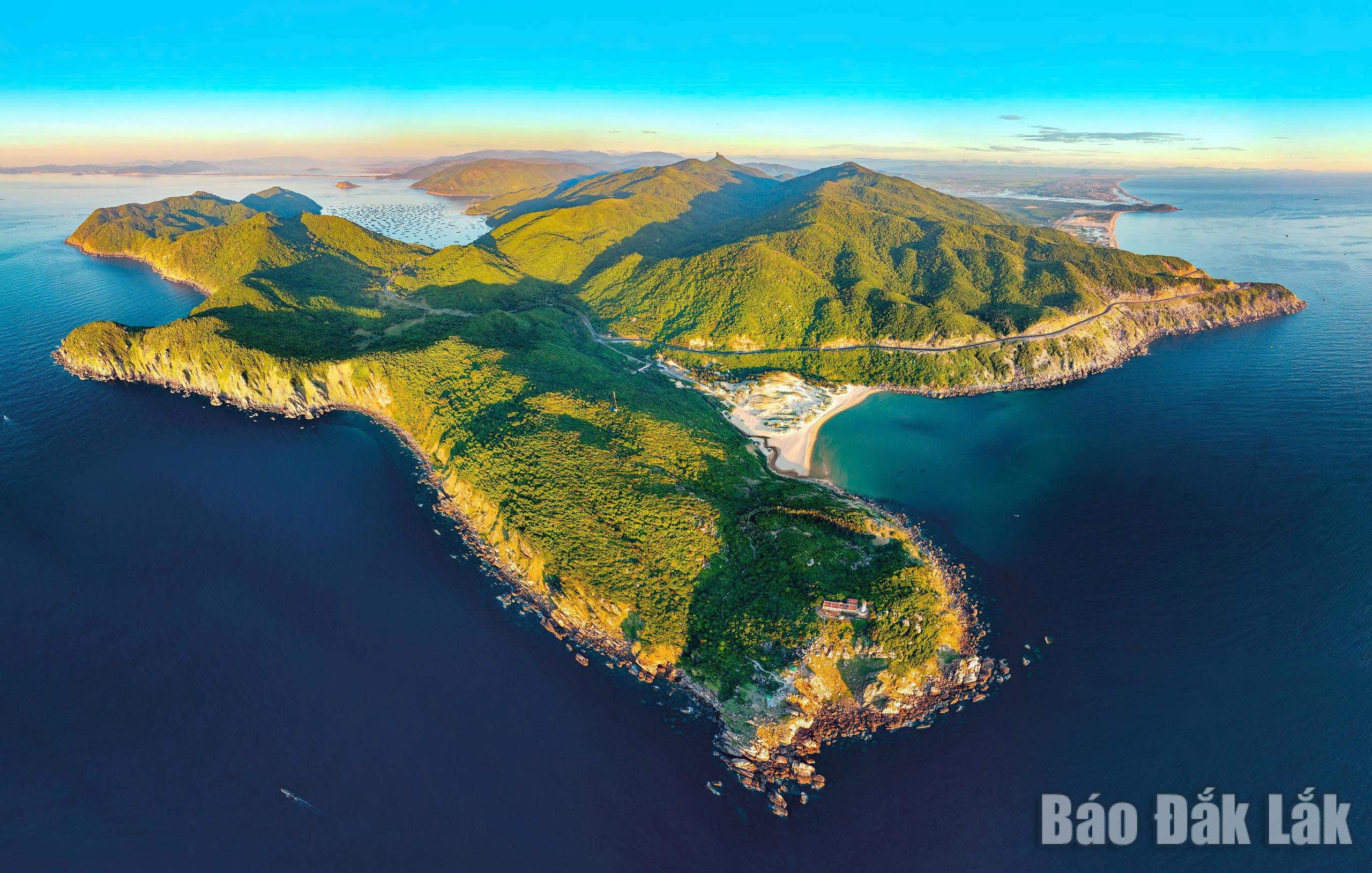 |
| Mui Dai Lanh - Bai Mon, a distinctive landscape within Phu Yen Geopark. |
In 2025, the Management Board of Phu Yen Geopark coordinated with experts from the Vietnam Geoparks Network to conduct field surveys and assessments. Initial findings indicate that Phu Yen Geopark possesses multiple values capable of meeting UNESCO’s stringent criteria.
According to experts, the most distinctive feature and greatest advantage of Phu Yen Geopark lies in its marine element. Vietnam currently has four UNESCO Global Geoparks: Dong Van Karst Plateau, Non Nuoc Cao Bang, Dak Nong and Lang Son, all located in mountainous and highland areas. By contrast, Phu Yen Geopark boasts a coastline of approximately 189 km, including offshore islands, lagoons, bays, rocky cliffs and beaches formed through geological processes hundreds of millions of years ago.
Unique geological and cultural heritage
Phu Yen Geopark is identified as part of the margin of the ancient supercontinent Gondwana, which existed billions of years ago in the Southern Hemisphere before breaking apart and drifting northwards approximately 200 to 180 million years ago.
 |
| A folk performance reflecting the maritime and riverine cultural identity, contributing cultural depth to Phu Yen Geopark, a factor highly valued by UNESCO. In the photo: Ba Trao performance at the Long Thuy whale worship festival. |
Another defining feature of Phu Yen Geopark is the Ba River, one of the few major rivers in central Vietnam connecting the Central Highlands to the East Sea. Accompanying it is a system of ancient river channels, small lagoons and coastal stretches where bentonite and diatomite formations containing numerous plant fossils were deposited, vividly reconstructing past natural environments.
The geological evolution of Phu Yen Geopark is recorded through multiple stages. From around 250 million years ago, the area underwent periods of sedimentation, magma intrusion and volcanic eruptions. Deep intrusive magma bodies cooled to form ancient granite now visible at Chop Chai Mountain, Nhan Mountain, Ca Pass and Da Bia, creating a striking contrast with the columnar basalt formations at Da Dia Reef, Hon Yen, Hon Dun and Mai Nha Volcano.
Beyond its geological significance, Phu Yen Geopark is home to rich ecosystems and a diverse cultural heritage. Within the geopark area are three special national relic sites, 20 national relics, 90 provincial-level relics and four items of national intangible cultural heritage, including the whale worship festival, traditional fish sauce making, traditional rice paper making and the Phu Yen folk art of Bai Choi, part of the Central Vietnam Bai Choi art inscribed by UNESCO as an Intangible Cultural Heritage of Humanity.
The Management Board of Phu Yen Geopark is actively coordinating with experts to continue in-depth research and surveys, strengthening the scientific basis of the UNESCO submission dossier, while implementing comprehensive heritage conservation measures, enhancing public awareness and promoting tourism. “According to the plan, in 2026-2027 the Management Board will advise the province to submit the dossier to UNESCO for consideration and recognition of Phu Yen as a UNESCO Global Geopark”, said Huynh Vinh Ngoc, Director of the Phu Yen Geopark Management Board.
Translated by KHUONG THAO