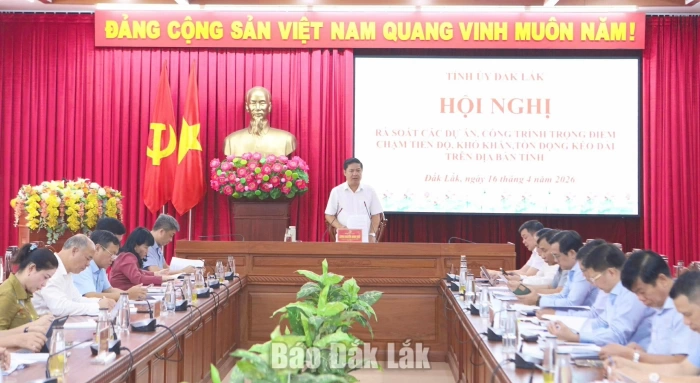
Identifying administrative procedure (AP) control as a breakthrough stage in administrative reform, Dak Lak province has in recent years implemented a range of coordinated, decisive measures.
The province has issued 186 decisions announcing AP lists, updating and fully publishing them on National Database on AP in line with regulations. Notably, it has completed a review of 1,092 key procedures, proposing simplification of 43 procedures across sectors including industry-trade, construction, health, and education. Agencies alongside units have intensified reviews of internal AP, ensuring at least a 20% reduction in procedures as well as compliance costs.
 |
| Officials guiding residents in completing administrative procedures at the provincial Public Administration Service Centre. |
At present, administrative system from provincial to grassroots levels operates in a coordinated manner. Eighteen AP groups under authority of 18 departments and sectors are now received as well as processed at provincial Public Administration Service Centre (PASC). At commune level, all 102 communes as well as wards have established similar PASC, with adequate personnel alongside equipment ensuring seamless service delivery.
Amid ongoing digital transformation, the province prioritises handling AP online. The Provincial iGate system has been continuously upgraded and integrated with electronic data repository, enhancing transparency in dossier processing.
By the end of 2025, Dak Lak had provided 2,191 AP on National Public Service Portal, achieving a 100% rate of fully online services for eligible procedures. In parallel, new interaction channels have been introduced, including “People ask - administrative leaders respond” programme, “Business Coffee” networking sessions, and monthly dialogue meetings, enabling provincial leaders to promptly address concerns raised by residents as well as enterprises.
 |
| Residents receiving guidance on handling administrative procedures in an electronic environment. |
PPC Vice Chairman, comrade Truong Cong Thai said AP reform efforts have been implemented in a coordinated manner, with clear improvements. Service quality has steadily improved, processing time shortened, while civil servant attitudes have been significantly enhanced, contributing to greater convenience for residents and businesses.
Despite notable outcomes, AP control still faces several bottlenecks. Data connectivity between provincial systems as well as national databases remains inconsistent, while IT infrastructure in some communes and wards is still limited. In addition, hesitation toward technology among residents in remote areas continues to hinder efforts to increase the proportion of online applications.
For 2026, Dak Lak has set targets to review as well as propose cuts or simplification for 100% of unnecessary, overlapping, or conflicting business conditions; and to abolish all business conditions applied to sectors not listed as conditional business lines under Law on Investment within local legal documents. The province will also prioritise upgrading equipment at PASC at all levels, while promoting AP implementation regardless of administrative boundaries.
Translated by HAI LOAN