
With a firm commitment to “leave no one behind,” Party committees and authorities at all levels across the province have been implementing a wide range of poverty reduction measures, striving to bring the poverty rate down to 2.13% by the end of 2026.
The province currently has 34,411 poor households, accounting for 4.13% of all households. Of these, 22,717 are ethnic minority households, representing 66.02% of the province’s poor households. Notably, 51 communes have relatively high poverty rates, ranging from 1.52% to 48.63%, with a combined 27,062 poor households, equivalent to 78.64% of the provincial total. Poverty in the province is multi-dimensional and is concentrated mainly in mountainous areas, ethnic minority communities, and households with no members capable of working. Major areas of deprivation include health insurance coverage, employment, sanitation conditions, and access to information.
 |
| The high-yield banana-growing model adopted by residents of Ea Kar Commune has proved effective, opening up a sustainable pathway out of poverty. |
Nguyen Duc Thang, Head of the Rural Development Sub-Department under the Department of Agriculture and Environment, said the province is vigorously implementing the National Target Program on Sustainable Poverty Reduction in a multi-dimensional, inclusive, and sustainable manner, with a focus on preventing households from falling back into poverty and preventing new cases of poverty. The ultimate goal is to provide sustainable livelihoods that enable poor households to lift themselves out of poverty while contributing to improvements in the socio-economic landscape of local communities.
In 2026, the province has been focusing on a coordinated set of measures to support targeted, effective, and sustainable production development. Priority is being given to poor ethnic minority households, poor households with members who have rendered meritorious service to the revolution, as well as children and women. Under the multi-dimensional poverty standards for the 2022–2025 period, the province aims to reduce its poverty rate to 2.13% by the end of 2026.
Livelihood support creates a pathway out of poverty
Support for production development and livelihood diversification, together with vocational training, job creation, and income improvement for poor and near-poor households with no members able to work, has been identified as a key solution to helping disadvantaged families gradually become self-reliant.
In implementing the National Target Program on Sustainable Poverty Reduction for the 2021–2025 period, Dak Lak has introduced a range of policies tailored to the practical needs of poor and near-poor households and ethnic minority communities, including vocational training, support with breeding cattle and crop seedlings, and concessional loans for production development.
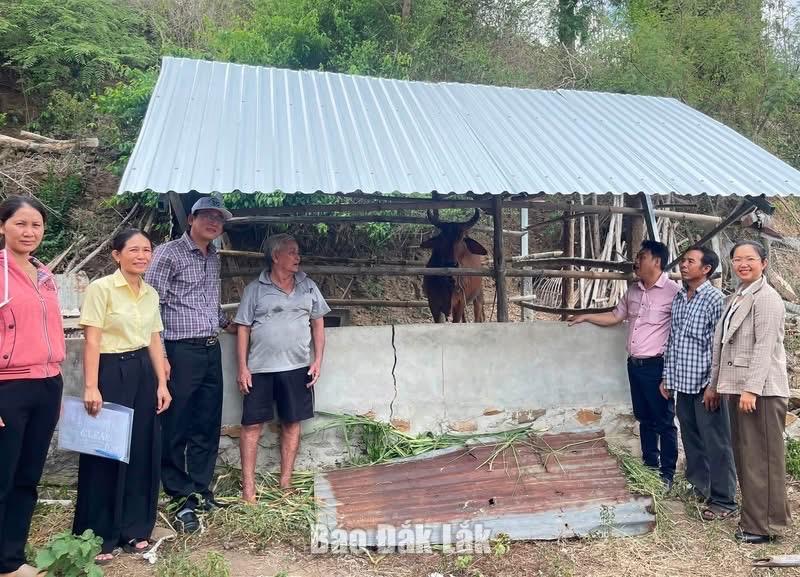 |
| Households in Tuy An Dong Commune receive cattle under a breeding-cow project designed to help them escape poverty. |
The province has provided production loans to 1,200 poor households, 5,650 near-poor households, and 10,450 households that have recently escaped poverty, enabling them to invest in production and gradually stabilize their livelihoods.
The family of H Nga NiE in Ya Wam A Village, Ea Kiet Commune, is among the near-poor households that have benefited from livelihood support. “After the Commune People’s Committee provided us with a breeding cow, my husband and I have been focusing on livestock farming and later invested in coffee and pepper cultivation and pig raising. Thanks to training courses and the farming techniques we learned, our livestock production has become more stable in recent years, our crops are growing well, and our family’s living conditions have gradually improved,” H Nga said.
According to Y Wal Mlo, Secretary of the Ea Kiet Commune Party Committee and Chairman of the Commune People’s Council, immediately after the administrative merger and the introduction of the two-tier local government model, the Commune Party Committee began implementing a number of initiatives to help local people escape poverty. Developing the local economy, effectively addressing social welfare issues, and improving both the material and spiritual well-being of residents will remain key objectives and priorities for the commune in the years ahead.
Mr. Nguyen Thien Van, Vice Chairman of the Dak Lak Provincial People’s Committee, said that in 2026 the province will make the fullest and most effective use of resources available under the National Target Programs for the 2026–2030 period, while integrating them with other programs, projects, and lawful funding sources to advance multi-dimensional, inclusive, and sustainable poverty reduction. The province will continue supporting poor and near-poor households in raising their incomes, gradually moving above the minimum standard of living, and reducing deprivation in access to basic social services in accordance with the multi-dimensional poverty standards.
Translated by THAO LINH


