The province is focusing on identifying high-risk areas and vulnerable groups, enabling proactive response planning. Disaster prevention coupled with control must be prepared early, closely aligned with actual conditions, with a shift from passive response towards risk management.
During the first nine months of 2026, the province experienced 13 natural disasters, mainly thunderstorms, whirlwinds and heavy rains during seasonal transitions. The events left two people dead, damaged 109 houses, alongside affected several infrastructure, transport and irrigation facilities, disrupting residents’ lives. According to the provincial Hydro-Meteorological Station, strong storms with complex, difficult-to-predict developments may still occur through the end of the year.
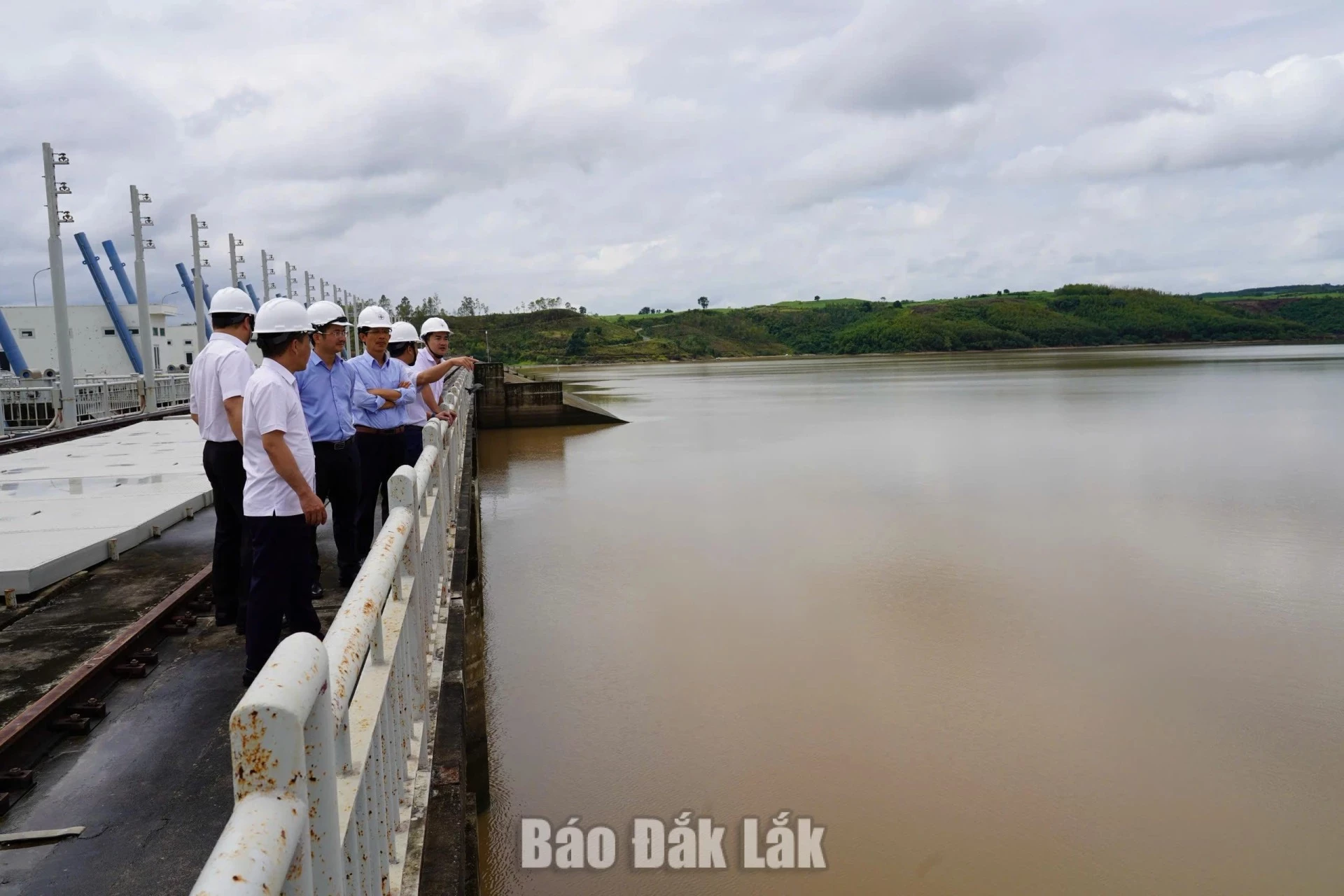 |
| The Industrial Safety Techniques and Environment Agency under the Ministry of Industry and Trade inspecting operations along with disaster prevention measures at the Ba Ha River Hydropower Plant. |
To strengthen response capacity, reviewing vulnerable locations ahead of the rainy along with storm season has become a key task. Nguyen Thanh Phong, Deputy Director of the Department of Agriculture and Environment, said 10 reservoirs coupled with dams at risk of becoming unsafe are being inspected and assessed to determine appropriate water storage plans. In the longer term, the sector will advise the PPC to seek funding from the Ministry of Agriculture and Environment for repairs as well as upgrades.
Regarding transport routes, the Department of Construction has also reviewed the entire network under its management, identifying 150 locations at risk of flooding, landslides or isolation. Of these, 30 sites require immediate priority treatment, mainly along National Highways 25, 19C, 27 and 29. These routes play a vital role in connecting residential areas, as well as facilitating search and rescue operations.
Moreover, the province has identified 156 areas at risk of flooding, 62 prone to flash floods, 35 vulnerable to landslides along with rockfalls, 55 exposed to storms, combined with 26 at risk from sea-level rise.
Proactive disaster response plans
Alongside on-the-spot forces, coordinated response plans have been organised for each area. The Provincial Military Command has signed coordination plans with 18 units under the Ministry of National Defence, Military Region and Provincial Police. Colonel Le Van Hung, Deputy Commander of the Provincial Military Command, said specific plans had been drawn up for mobilising and allocating personnel, equipment combined with vehicles across each area. Accordingly, 26,000 personnel and more than 38,500 vehicles alongside pieces of equipment have been reviewed on the ground, ready for rapid mobilisation in emergencies.
 |
| The PPC holding a thematic conference on natural disaster prevention and control. |
For transport infrastructure, the “four-on-the-spot” approach has been translated into deploying personnel, machinery and materials near nearly 150 locations at risk of flooding, landslides or isolation. Warning signs, delineator posts together with water-level gauges have been installed, alongside traffic diversion plans and alternative routes. Ten construction units coupled with six consultancy firms are ready to mobilise 379 personnel, 396 machines and pieces of equipment, as well as reserve materials and vehicles, in response to storms, heavy rain along with other incidents.
Each unit must have a thorough understanding of its assigned area alongside develop plans suited to each type and level of natural disaster, based on actual response capacity. Communes together with wards must clearly identify hazardous areas and the number of affected households, commanders as well as those responsible for each locality; specify the forces, vehicles and materials available for mobilisation; define evacuation routes, shelters alongside relocation times; and establish clear warning, reporting along with reinforcement procedures.
Comrade Nguyen Thien Van, PPC Vice Chairman
Translated by HAI LOAN