Amid rapid changes in the labour market, universities and colleges across Dak Lak Province are gradually overhauling their training programmes, shifting from a supply-driven approach based on existing curricula towards education that is more closely aligned with actual business coupled with societal needs.
The growth of the digital economy, major infrastructure projects and changes in production methods are reshaping workforce demand province-wide. Sectors including agricultural processing, logistics, IT, tourism, management combined with agricultural supply-chain operations increasingly require workers who not only possess professional expertise but are also technological proficiency, equipped with practical skills and able to adapt to new working environments.
In agriculture, the technology adoption in production, processing and distribution is changing workforce requirements. Rather than simply performing manual tasks or following fixed procedures, employees are now required to operate equipment as well as software, work with data and adapt to modern production processes.
In the service, industrial along with healthcare sectors, demand for a higher-quality workforce is also increasing, requiring knowledge and skills taught in educational institutions to be continuously updated.
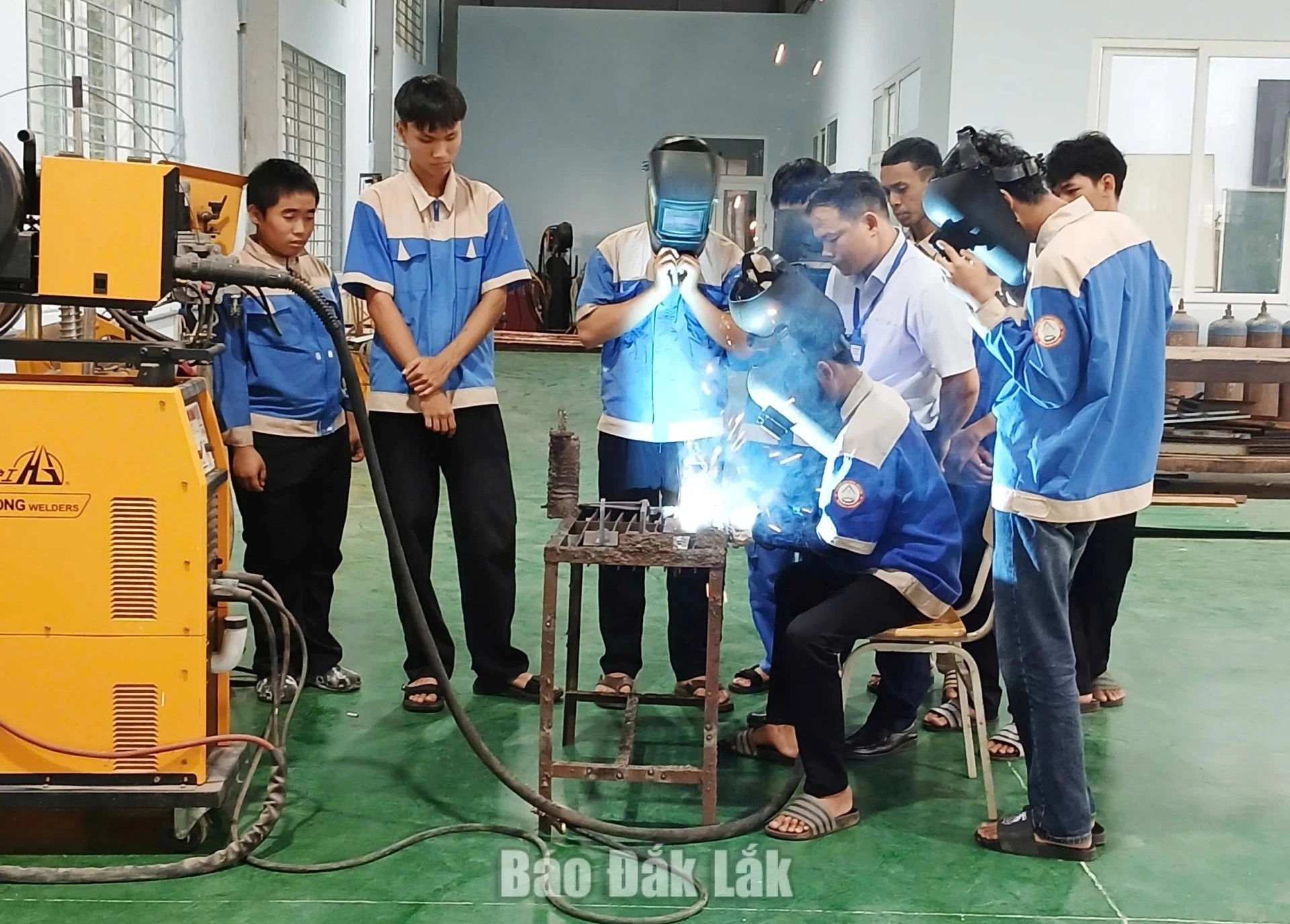 |
| Students of Dak Lak College practise welding skills. |
According to provincial leaders of universities alongside colleges, current labour-market shifts have created a clear imperative for educational institutions: they can no longer train students simply on the basis of what they already offer, but must focus on what the market actually needs. Training disciplines, curricula and individual courses are reviewed periodically with input from experts coupled with employers, helping reduce overly theoretical content while strengthening practical knowledge and skills.
Educational institutions change their training approach
At Buon Ma Thuot Buon Ma Thuot University of Medicine and Pharmacy, training programmes are designed around the workforce requirements at healthcare facilities, hospitals, clinics alongside care providers. The university works with employers to develop training plans, expand clinical practice and organise internships tailored to specific job positions, helping students strengthen both professional competence as well as career adaptability. As a result, many graduates secure employment soon after graduation, while employment rates across the university’s training programmes remain high.
A similar approach has been adopted at Dak Lak College, where vocational skills are placed at the heart of training. Around 70% of training time is devoted to practical learning in workshops and at businesses, enabling students to develop occupational skills as well as gain direct exposure to real equipment and production processes.
Dr. Dang Van Lai, Rector of the college, said that in addition to professional knowledge combined with vocational skills, the institution places strong emphasis on soft skills, foreign languages, digital proficiency and industrial working practices. As a result, around 90% of graduates find employment related to their fields of study as well as are able to meet workplace requirements without requiring retraining.
In response to labour-market changes, educational institutions are moving away from training based on fixed, pre-designed programmes towards training tailored to specific job requirements. The aim is to equip learners with relevant knowledge, practical skills and the adaptability needed in an increasingly dynamic labour market.
According to Assoc. Prof. Dr. Le Duc Niem, Vice Rector and Chairman of the Science and Training Council for the 2025–2030 term at Tay Nguyen University, training programmes must be regularly updated to keep pace with labour-market changes. Aligning learning outcomes, course content alongside specialised modules in line with the practical requirements of each field has become an essential task across the university’s faculties.
Translated by THAO LINH