Rooted in the coastal community’s worship of Whales (Ong fish), Lo 1 Whale Temple, Lo 2 Whale Temple and Lo 3 Whale Temple are being prepared by Hoa Hiep Ward, in coordination with relevant agencies, for submission for provincial-level historical coupled with cultural relic recognition in 2026.
Preserving these sites will not only help safeguard longstanding cultural values but also provide a foundation for promoting the distinctive identity of coastal fishing villages in tandem with community-based tourism development.
Throughout their formation and development, Phu Tho, Phu Tho 1, Phu Tho 2 along with Phu Tho 3 residential quarters in Hoa Hiep Ward have retained distinctive cultural traditions of communities closely associated with fishing. Among their most significant heritage sites, Whale Temples serve as places for practising folk beliefs while preserving historical traces of village settlement, livelihoods and the spiritual life of generations of fishermen.
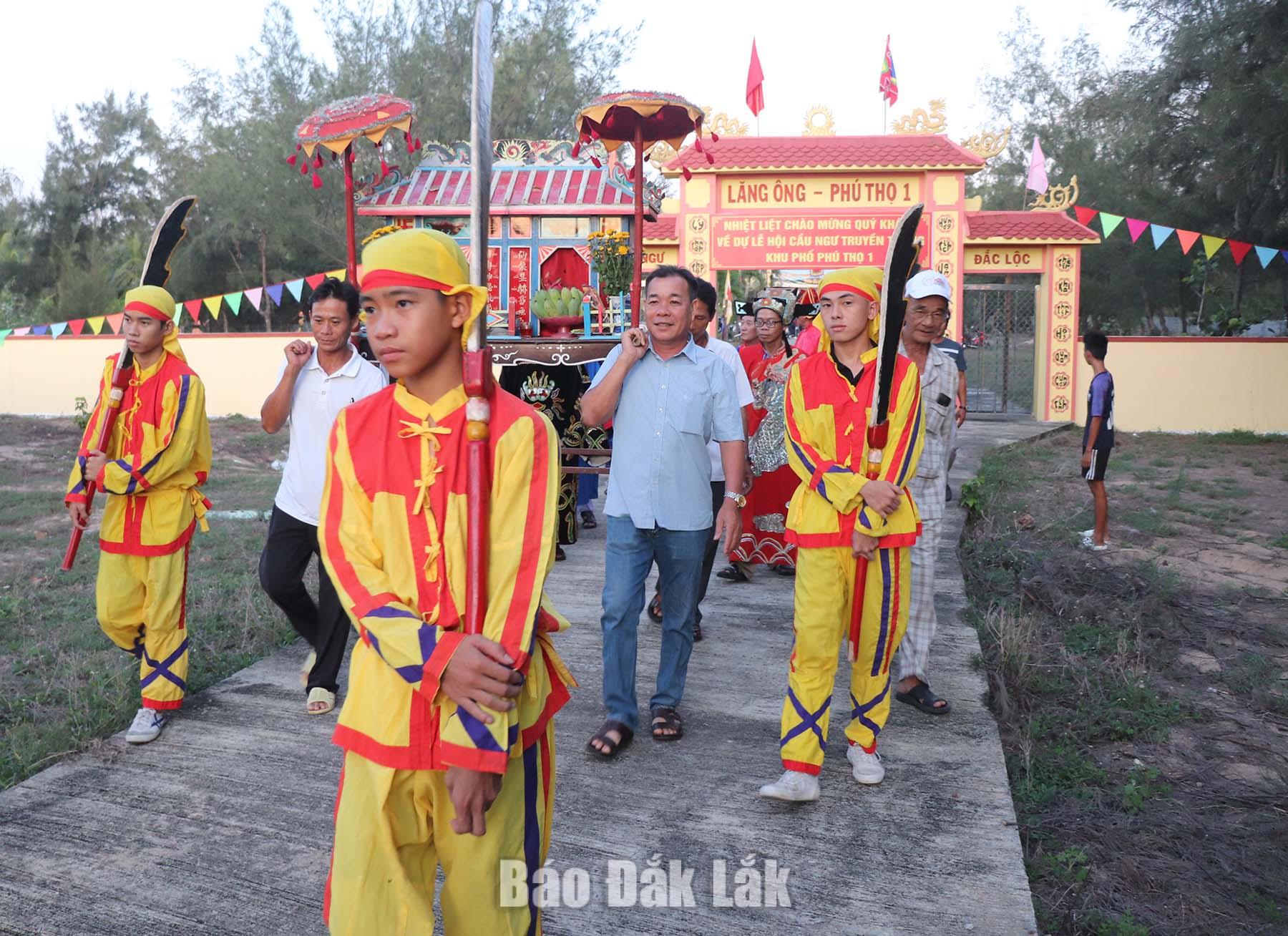 |
| A ritual performed during the Whale Worshipping Festival at Lo 1 Whale Temple, Phu Tho 1 residential quarter, Hoa Hiep Ward. |
According to local lore, fishermen travelling by sailing boats once stopped in this area, where they established camps, built fish-salting kilns and constructed temples dedicated to God Nam Hai (the Southern Sea Deity). In later years, local residents also worshipped Prior worthies, who played a pioneering role in establishing the settlements. Over generations, the Whale Temples have become important spaces for the community’s spiritual alongside cultural activities. Traditional rituals, particularly the Whale Worshipping Festival, not only reflect the beliefs of coastal communities but also help preserve customs and practices, strengthen community bonds as well as remind younger generations of their ancestors’ contributions. Protecting these sites therefore means safeguarding not only places of worship but also collective memories and cultural values shaped by the fishing villages’ historical development.
Archaeological researcher Phan Danh Hanh said preparing dossiers for the proposed recognition of Whale Temples was a practical step towards preserving heritage closely associated with the community’s spiritual life. The process would not only formally recognise their historical and cultural significance but also establish a basis for their long-term management coupled with protection. This would provide local authorities with additional legal grounds to strengthen management responsibilities, promote community participation and reduce the risk of traditional values fading over time.
On this basis, Hoa Hiep Ward is working with the Phu Yen Geopark Management Board to complete scientific dossiers seeking provincial-level historical and cultural relic recognition for the three Whale Temples.
Comrade Huynh Nguyen Ngoc Giang, Chairman of the Hoa Hiep Ward People’s Committee, said the locality plans to link preservation of the Whale Temples with community-based tourism development while respecting traditional cultural values. Heritage use must go hand in hand with protecting worship spaces, preserving the authenticity of rituals and avoiding commercialisation that could distort the community’s cultural identity. In particular, local residents will continue to play a central role in safeguarding, practising while passing on their heritage. When properly protected and harmoniously integrated into community life, these traditional values can be sustained as well as become a distinctive feature of cultural discovery in the coastal area of Hoa Hiep.
Translated by HAI LOAN