The reform has brought major changes to organisational structures and operational methods at grassroots level, while simultaneously creating greater demands for restructuring governance capacity.
 |
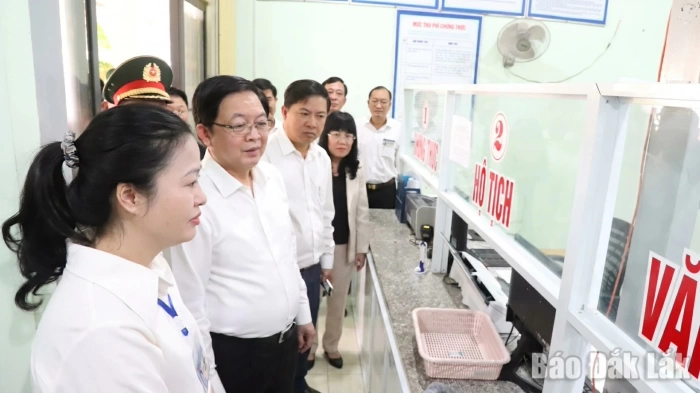
| Party Central Committee member, Provincial Party Secretary and Head of the provincial National Assembly Deputies Delegation, comrade Luong Nguyen Minh Triet inspecting operations at the Public Administrative Service Centre of Ea Kao ward. |
Reducing intermediate layers has increased autonomy of communes together with wards, yet also created significant demands for improving decentralisation and delegation mechanisms, alongside ensuring corresponding resources. Therefore, improving decentralisation along with delegation mechanisms to ensure that grassroots authorities have sufficient operational capacity, together with building a contingent of officials capable of meeting new governance requirements, has become an urgent and crucial task.
Associate Professor, Dr Doan Minh Huan, Politburo member and Director of the Ho Chi Minh National Academy of Politics, affirmed that two-tier local government model is placing increasingly high demands on grassroots officials, particularly regarding systems thinking, development governance capacity combined with ability to effectively address practical issues arising in practice. Therefore, attention must be given to improving training, fostering creativity while transforming governance mindset away from “management” to “enabling and service-oriented governance”.
Simultaneously, accelerating salary policy reform based on job positions has become increasingly urgent. Comrade Nguyen Tien Ha, Deputy Head of the Economic, Infrastructure and Urban Division of Buon Ma Thuot ward, noted that following the merger, workloads had increased sharply while manpower remained limited, forcing many officials to work extended hours. Drawing from practical experience, he together with numerous other officials and civil servants hope that appropriate salary mechanisms as well as remuneration policies will soon be introduced.
Improving the model and enhancing operational efficiency
Further improving governance foundation, enhance implementation capacity and build a synchronised operational mechanism so that the new model can truly operate effectively in practice remain among key tasks currently being prioritised by the province.
Party Central Committee member, Provincial Party Secretary and Head of the province’s National Assembly Deputies Delegation, comrade Luong Nguyen Minh Triet stated that the province is focusing on consolidating organisational apparatus along with standardising contingent of officials in a scientific and transparent approaches, while reforming recruitment and evaluation processes linked directly with work performance and public satisfaction.
 |
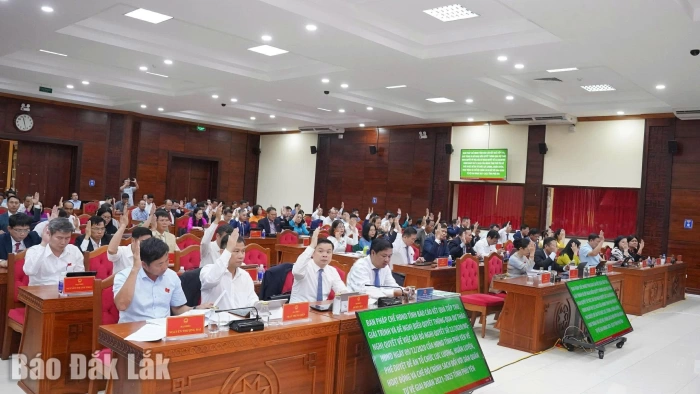
| The Central Government needing mechanisms to ensure appropriate income, salaries as well as support based on job positions in order to motivate and attract high-quality human resources to grassroots levels. |
According to the Provincial Party Secretary, alongside promoting rotation of officials to grassroots levels, the province is placing particular emphasis on building a contingent of officials with innovative thinking and a willingness to think boldly, act decisively as well as take responsibility in public duty performance. Training and capacity building continue to be identified as a breakthrough to improve governance skills, leadership capacity combined with ability to apply emerging technologies among officials.
The province will further strengthen decentralisation and delegation through clearly defined responsibilities together with authority, increasing grassroots autonomy while enhancing inspection, supervision and timely resolution of emerging difficulties. Concurrently, the province will continue prioritising investment in modern alongside synchronized digital infrastructure, particularly in remote, isolated and ethnic minority areas; strengthening data connectivity and interoperability; raising quality of online public services; while accelerating development of digital government.
Moreover, the province has proposed that the Central Government and ministries along with relevant agencies promptly complete the legal framework for two-tier local government model, while unifying data platforms coupled with interconnected administrative procedure settlement systems to ensure synchronised operations from the provincial to grassroots levels. In particular, issues related to job positions, salary mechanisms, allowance policies and specialised staffing quotas have also been proposed for resolution in line with practical requirements.
Translated by KHUONG THAO