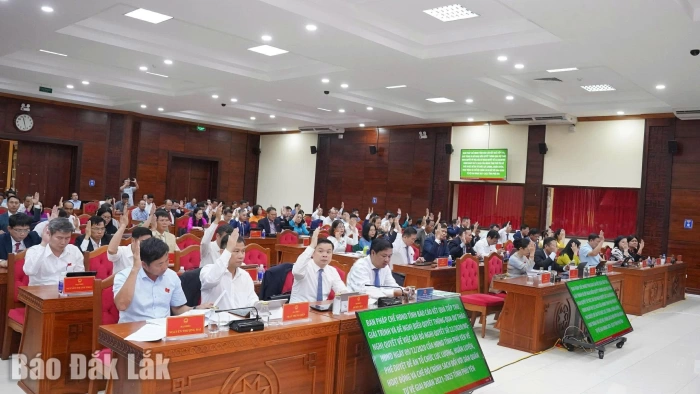
After one year of implementing the two-tier local government model, Dak Lak has recorded marked progress in administrative reform (AR), decentralisation, delegation of authority and service delivery for residents along with enterprises.
From streamlining organisational apparatus and renewing governance thinking to accelerating digital transformation (DX), province is gradually building a modern, effective, efficient combined with people-centred administration, creating fresh momentum for sustainable development in the new period.
Renewing governance thinking
The two-tier local government model is a major policy of the Central Government aimed at building a streamlined, robust, efficient and effective administrative apparatus; advancing decentralisation along with delegation of authority under principle of “localities decide, localities implement and localities take responsibility”, while identifying science-technology, innovation and digital transformation (S.T.I.D) as key drivers of development. Beyond reducing intermediate layers, the model marks a shift from multi-tier administration towards direct governance, enhancing accountability at provincial coupled with commune levels in pursuit of a people-centred, development-oriented administration.
 |
| Officials and residents of Buon Ho Ward welcoming Provincial Party Secretary, comrade Luong Nguyen Minh Triet as he attending the Great National Solidarity Festival in An Binh 7 residential quarter. |
For Dak Lak, this requirement has become even more urgent following administrative restructuring. With an area exceeding 18,000 sq.k, ranking third nationwide and a population of more than 3.3 million, placing 17th nationally, alongside 45 ethnic groups living across 102 commune-level administrative units, operation of the two-tier governance model must align with the provincial vast geography, diverse regions combined with demographic characteristics.
Recognising significance of this reform, Provincial Party Committee, People’s Council and People’s Committee have exercised decisive, synchronised leadership as well as direction; promptly issuing programmes, plans and implementation roadmaps, while accelerating organisational restructuring in parallel with AR and DX. Throughout implementation, the province has simultaneously carried out administrative reorganisation, maintained socio-eco development, safeguarded national defence-security along with ensured uninterrupted services for residents and enterprises.
After one year of operation, Dak Lak has recorded clear progress in AR, decentralisation together with delegation of authority, significantly reducing processing time and creating greater convenience for residents combined with businesses. Previous bottlenecks caused by multi-level approval procedures have largely been removed through stronger decentralisation mechanisms. Numerous issues related to land, public investment, agriculture alongside environment are now being handled more promptly at grassroots level.
| A people-centred administration is defined not only by geographical proximity but also by a service-oriented mindset, accountability and the ability to promptly address issues facing residents along with businesses. The new model can only be considered truly successful when every official, agency and level of government proactively embraces reform; provincial authorities genuinely play a facilitating and accompanying role; commune-level administrations demonstrate initiative alongside sufficient capacity; and residents alongside enterprises clearly feel positive changes in every AP coupled with daily transaction. |
Notably, enhanced delegation of authority by Provincial Party Standing Committee to PPC Party Committee together with commune-level authorities in finance and investment particularly adjustments to approval authority for investment policies has substantially shortened administrative processing times as well as expanded development opportunities for enterprises.
Simultaneously, commune-level administrations have been granted broader authority in handling administrative procedures (APs) and delivering essential public services, enabling residents along with businesses to settle matters directly within their localities instead of going through multiple intermediate levels as before. Public administrative service centres (PASC) at all levels are operating smoothly and stably, contributing to a sharp decline in overdue dossiers.
With public coupled with business satisfaction serving as a key performance benchmark, together with high rates of dossier digitisation, the two-tier local government model in Dak Lak has not only streamlined administrative apparatus but also gradually built a more professional, transparent and people-oriented administration.
Continuing to improve and ensure effective operations
Beyond initial positive outcomes, Dak Lak has candidly acknowledged that operating the two-tier local government model across a vast area characterised by diverse ethnic communities, religions as well as terrain continues to pose considerable challenges in terms of organisational structure and grassroots resources.
The greatest pressure stems from shortages together with imbalances in specialised personnel at commune level, while workload transferred through decentralisation continues to rise sharply. Capacity among grassroots officials remains uneven, with numerous positions requiring staff to take on multiple roles or work outside their professional expertise, particularly in IT, land administration, finance-budget management and investment. Remuneration policies have yet to match practical demands, while remote and disadvantaged areas continue to struggle in attracting high-quality human resources.
 |
| Provincial Party Secretary, comrade Luong Nguyen Minh Triet inspecting operation of the two-tier local government model at the Public Administrative Service Centre of Hoa Phu Commune. |
Concurrently, administrative and digital infrastructure (DI) at commune level still faces numerous shortcomings. Many offices following administrative mergers remain scattered alongside cramped, creating difficulties in coordination and handling of work. IT infrastructure lacks synchronisation as well as has yet to meet DX requirements. Disposal and management of surplus public land combined with properties after mergers have progressed slowly due to legal obstacles, valuation difficulties and limited investor interest. Procurement of official vehicles has also encountered bottlenecks because of prolonged alongside complicated bidding procedures.
In line with spirit of Directive No. 18/CT-TTg issued by Prime Minister in May 2026, Dak Lak is concentrating efforts on resolving existing obstacles and further refining the two-tier local government model towards a more streamlined, effective alongside efficient administration. The province is also accelerating decentralisation and delegation of authority in parallel with stronger inspection, supervision together with accountability mechanisms, aiming ultimately to provide better services for residents and businesses.
Alongside these efforts, the province is prioritising development of a capable and resilient commune-level contingent of officials along with civil servants able to meet demands of the new context; accelerating DX, modernising administration, improving AP settlement quality, tightening administrative discipline while using public satisfaction as a benchmark for evaluating effectiveness of grassroots authorities.
For the 2026-2031 period, Dak Lak has identified its guiding motto as: “Discipline and responsibility; proactive, timely, streamlined as well as efficient action; acceleration and breakthrough.” On that basis, the province will continue improving decentralisation mechanisms, investing comprehensively in DI while expanding AI application in governance and administration, with a target of reducing at least 50% of administrative processing time combined with compliance costs during 2026 alone. The province will also continue investing in facilities and human resource training, while introducing suitable support mechanisms for commune-level administrations, especially in large-population areas, remote regions alongside localities with distinctive conditions. At the same time, efforts will focus on building a professional, responsible and dedicated civil service committed to serving the people.
Alongside internal efforts, Dak Lak will continue proposing that the Central Government, ministries together with sectors further refine mechanisms and policies aligned with the two-tier local government model; strengthen guidance and promptly remove difficulties arising during implementation; while supporting investment in DI, databases along with human resources to ensure smooth, effective and efficient administrative apparatus operation in line with development requirements in the new period.
With strong political determination, coordinated participation of the entire political system and broad public consensus, Dak Lak remains confident that the two-tier local government model will continue to be refined as well as operated effectively, becoming an important driving force for rapid, sustainable development and improved services for residents coupled with enterprises in the years ahead.
Comrade Luong Nguyen Minh Triet
Member of the Party Central Committee, Secretary of the Provincial Party Committee and Head of the provincial National Assembly Deputies Delegation
Translated by HAI LOAN