From sprawling coffee hills and fruit-laden durian orchards to villages coupled with homestays nestled in green surroundings spaces, alongside seaside communities retaining their pristine character, Dak Lak is gradually shaping a community-based tourism model rooted in ecological agriculture.
In recent years, an increasing number of tourists have opted to explore Dak Lak’s distinctive agricultural production areas rather than simply visit conventional attractions.
In the coffee-growing areas around Buon Ma Thuot and Ea Kao, durian orchards of Krong Pac alongside Krong Nang, and the Ngoc Lang VietGAP vegetable-growing area in Tuy Hoa ward, visitors can pick their own produce, learn about clean production and processing methods while sampling it directly at the farms.
 |
| Visitors picking coffee at a farm. |
This trend has encouraged many farming households along with enterprises to shift from conventional production towards multi-value models combining agriculture with experiential tourism and OCOP product promotion.
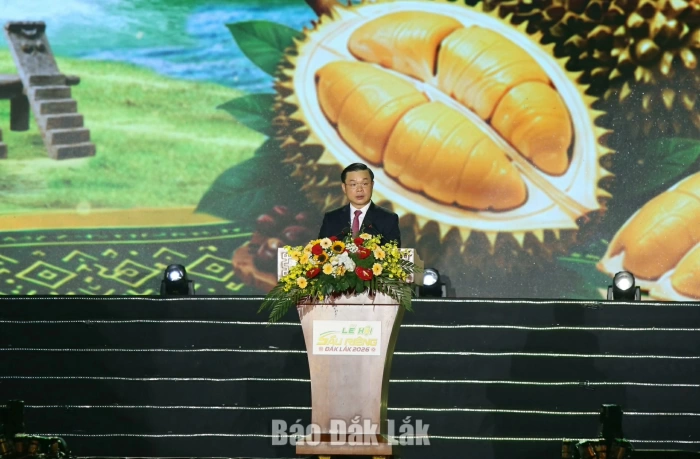
At the beginning of this year’s harvest season, numerous durian orchards in Ea Knuec commune have become bustling destinations, attracting visitors who tour the orchards, hand-pick and enjoy ripe durians while learning about safe production processes.
According to Mr. Le Van Vuong, Director of Vuong Thanh Cong Production and Trading Co., Ltd. (Ea Kao ward), the enterprise’s more than 20 ha of organic coffee farms welcome around 40-50 groups of visitors from inside coupled with outside the province each year. Visitors experience the entire process, from touring the farms and harvesting to preliminary processing, coffee bean selection, roasting, grinding as well as brewing, before sampling finished products.
Linkages create sustainable value
Alongside farms, homestay networks in Buon Ma Thuot, Ea Kao, Hoa Hiep, Van Hoa and neighbouring areas are also actively connecting with farming households to develop green experiential tours, allowing visitors to immerse themselves in the local life.
According to Mr. Ho Hau, owner of two homestays in Ea Kao ward, developing sustainable community-based tourism requires, above all, close linkages among local residents, accommodation establishments, restaurants, homestays, local authorities and tourism operators.
 |
| Visitors exploring the organic coffee-growing model developed by Vuong Thanh Cong Production and Trading Co., Ltd. in Ea Kao ward. |
Following the expansion of its administrative boundaries, another advantage of Dak Lak benefits from the seamless connection between its forests alongside the sea. From coffee, durian and pepper-growing areas to the coastal villages in Hoa Hiep together with Tuy An Dong, visitors can enjoy a diverse journey within a single trip: strolling around farms in the morning, enjoying the sea breeze in the afternoon, savouring fresh seafood and immersing themselves in the daily life of coastal communities.
According to Mr. Nguyen Minh Hoai, Chairman of the Van Hoa Commune People’s Committee, the locality is leveraging its ecological landscapes, traditional culture as well as distinctive local products to develop sustainable tourism, with residents playing a central role in preserving and promoting cultural values through tourism development, thereby creating jobs, increasing incomes while improving livelihoods.
For community-based tourism to thrive over the long term, infrastructure investment and service improvement quality must go hand in hand with environmental protection, cultural preservation combined with development of products reflecting the distinctive characteristics of each locality. When every farm becomes a destination, every farmer becomes an “ambassador” for their homeland, and every agricultural product can tell the story of its land, green experiences can become a novel driving force, helping shape community-based tourism in Dak Lak as a distinctive, sustainable as well as culturally rich sector.
Translated by KHUONG THAO