Low-emission rice fields, coupled with integrated value chains spanning agricultural production, deep processing and markets, are paving the way for sustainable, multi-value agricultural development across Dak Lak's border areas.
Restructuring production to create novel value
Ia Lop, a border commune, once faced harsh weather conditions and nutrient-poor soil. Today, its large-scale paddy fields, developed under a high-tech farming model integrated in circular agriculture, have reshaped the rural landscape.
Mr. Bui Van Danh, a farmer participating in the large-scale field model, said using unmanned aerial vehicles (UAVs), or drones, for seeding and crop spraying has significantly lowered labour costs while promoting more uniform crop growth and improved economic returns.
 |
| Farmers harvesting rice in a large-scale paddy field. |
Beyond technology adoption, the model's defining feature lies in a fundamental shift in farming practices. Rather than relying heavily on chemical fertilisers, the cooperative encourages farmers to utilise agricultural by-products, improving soil quality, cutting input costs while reducing greenhouse gas emissions.
Ia Lop's large-scale farming area currently spans around 300 hectares. Instead of being sold individually at farm gates, harvested paddy is transported directly to a modern processing system meeting traceability requirements alongside low-emission production standards. The processing plant can procure up to 1,200 tonnes of paddy daily, with capacity reaching 8-10 tonnes of rice an hour, laying the foundation for a distinctive border-region rice brand rather than exporting raw agricultural produce.
According to Mr. Vu Dinh Muoi, Chairman of the Board of Directors of Phan Gia Company Limited, the company goes beyond purchasing paddy by participating across the entire value chain, from supplying seed varieties and organic fertilisers to signing off-take agreements with farmers. This long-term partnership gives farmers greater confidence in production while raising rice value through sustainable linkages between businesses and farming households.
Building a sustainable development ecosystem
In Ea Sup Commune, the farming model developed by Ms. Nguyen Thi Bich offers compelling evidence that ecological agriculture can generate multiple layers of value from a single area of farmland.
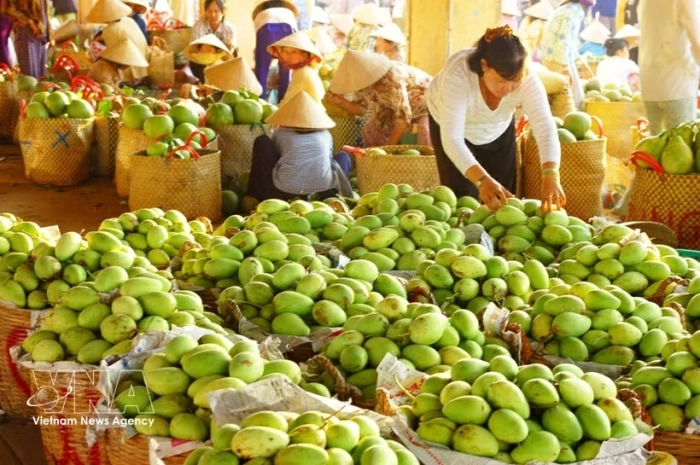
Through soil restoration, organic cultivation and years of studying crop characteristics, Bich has transformed two hectares of barren land into a circular farming system comprising 1,550 Ruby guava trees alongside 500 green-skin pomelo trees, generating annual revenue exceeding 3.6 billion VND.
 |
| Ms. Nguyen Thi Bich showcasing products from her integrated value chain. |
Rather than depending solely on fresh fruit sales, she has expanded the value chain beyond primary production into deep processing. Guavas failing to meet commercial standards are turned into syrup, wine and essential oil, while guava leaves are processed into herbal tea. Grade-three pomelos are further converted into essential oil, fermented juice combined with jam, leaving virtually no agricultural by-products unused.
Beyond generating income for her family, the model provides stable employment for five local workers, each earning 6-8 million VND a month. It also partners with farming households to expand raw-material areas, promote organic cultivation while sharing digital marketing skills.
According to Ms. Nguyen Thi Mien, Chairwoman of Ea Sup Farmers' Association, Nguyen Thi Bich's model ranks among the commune's leading examples of applying science and technology, advancing circular economy development, coupled with deep processing. It has increased product value, reduced waste and gradually established a sustainable raw-material production area.
The integration of digital technology, green farming practices alongside circular thinking is transforming once-barren border land into a multi-value economic landscape. More importantly, it demonstrates that agriculture in border areas is evolving beyond poverty alleviation into a driving force for sustainable development.
Translated by HAI LOAN