The 12-billion-USD export target remains achievable given solid output growth and generally favourable market conditions. However, any fourth-quarter slowdown would not necessarily reflect raw material shortages but also impacts on economic efficiency amid rising material and fuel costs.
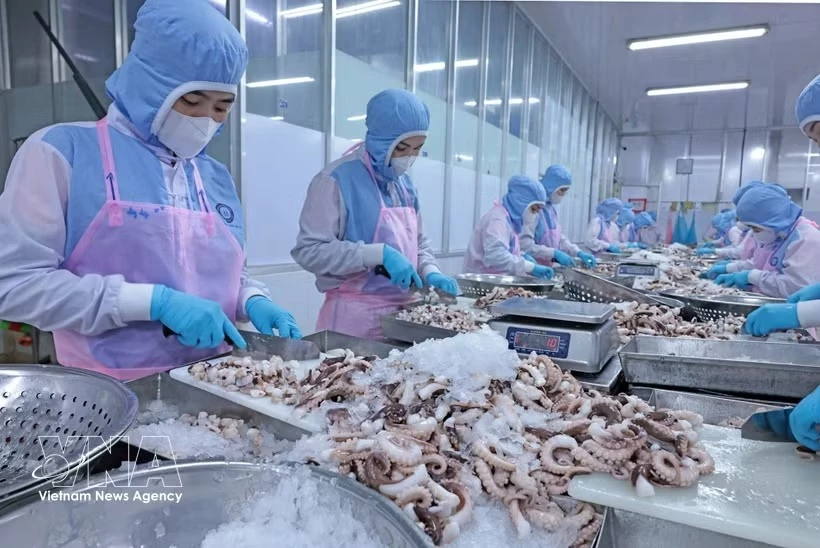 |
| Workers process octopus for export to the Japanese market at Huy Nam Company in An Giang province. (Photo: VNA) |
Viet Nam’s fisheries output is estimated at nearly 7.9 million tonnes in the first nine months of 2026, up 3.9% year-on-year, supporting the sector’s annual export target of 12 billion USD. However, rising input costs, supply competition and slowing demand in some major markets are putting pressure on the sector in the remaining months.
According to the Ministry of Agriculture and Environment (MAE), production continued to grow in September, with brackish-water shrimp farms entering their peak harvest season, tra fish production remaining stable and favourable marine fishing conditions helping ensure supplies for domestic consumption and export processing.
During January–September, output included 5.41 million tonnes of fish, up 2.8%; nearly 1.38 million tonnes of shrimp, up 7.1%; and 1.1 million tonnes of other aquatic products, up 5.8%. Aquaculture remained the main growth driver, supported by technological applications that improved productivity, quality and efficiency.
In the Mekong Delta, shrimp-rice and shrimp-mangrove farming models continued to deliver results, while high-tech intensive farming expanded. Stable tra fish production and growth in tilapia and marine aquaculture also helped diversify supplies.
According to the Vietnam Association of Seafood Exporters and Producers (VASEP), shrimp exports reached 3.75 billion USD in the first nine months, up 11% year-on-year and accounting for about 41% of total fisheries export revenue.
However, slower growth in September reflected intensifying supply competition and weaker market absorption. As harvesting peaked in several localities, whiteleg shrimp prices fell in parts of the Mekong Delta, highlighting the need to coordinate harvesting, purchasing and processing to protect farmers’ incomes.
Tra fish exports totalled 1.74 billion USD, up 10.7%. VASEP said tighter supplies of some wild-caught whitefish have created opportunities for Vietnamese tra fish, whose competitive prices and stable supply are attracting greater interest in several markets.
Kyokuyo’s continued introduction of the product through professional distribution channels in Japan is a notable development although the market remains relatively small, VASEP noted.
In key Mekong Delta provinces, raw tra fish prices remained favourable, supported by strong demand from processing plants preparing for the year-end export peak.
The MAE forecast that raw shrimp and tra fish prices could recover in the fourth quarter as supplies tighten and businesses step up purchases ahead of the year-end consumption season.
Phung Duc Tien, Chairman of the Vietnam Fisheries Society, said the 12-billion-USD export target remains achievable given solid output growth and generally favourable market conditions. However, he noted, any fourth-quarter slowdown would not necessarily reflect raw material shortages but also impacts on economic efficiency amid rising material and fuel costs.
VASEP forecast that exports could lose momentum in the fourth quarter after accelerating in the third as many orders for year-end consumption have been delivered early. China and the Association of Southeast Asian Nations (ASEAN) markets are expected to provide support but might not fully offset weaker demand in the US, the European Union and Japan.
To achieve the annual target, the sector needs to further stabilise raw material supplies, improve product quality and production efficiency, strengthen disease control and align farming with market demand. Closer links among farmers, fishemen and processors, alongside flexible production planning, product diversification and cost control, will be essential to maintaining competitiveness and increasing value across the supply chain.
VNA