After one year of operating the two-tier local government model, the cadre of officials and civil servants, especially at the grassroots level, has been fundamentally strengthened as well as consolidated, meeting the requirements for local leadership, management, and administration.
Binh Kien ward was one of the localities selected to pilot the two-tier local government model from June 2025. Comrade Nguyen Quoc Thang, Chairman of the Ward People’s Committee, said that to maximize the capacity of officials, the tasks of assigning, transferring, and rotating officials together with civil servants are carried out based on assessments of their practical capabilities, ensuring compliance with regulations and creating internal consensus. Numerous officials along with civil servants have quickly adapted, are capable of handling multi-field work, and are proficient in using digital technology. The increased pressure also presents an opportunity for the team to grow alongside adapt to new management requirements.
 |
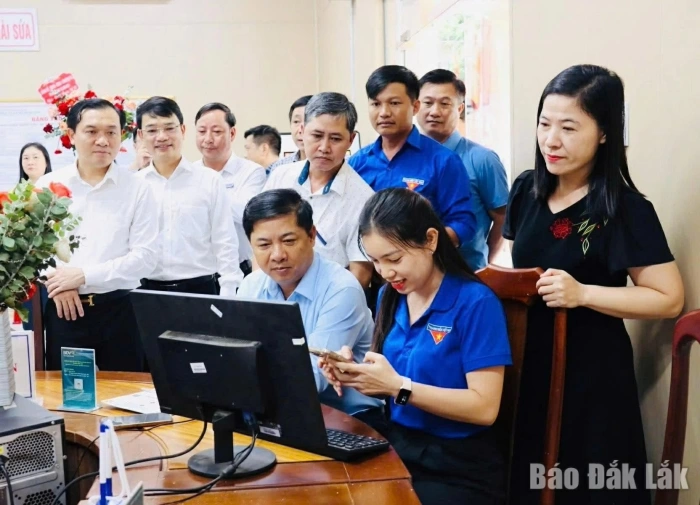
| The leader of the Ea Knop Commune Public Administrative Service Center inspecting and supervising the process of supporting people in using online public services. |
However, the practical operation of the two-tier local government model still reveals several limitations, including the organizational structure not being truly synchronized, the information technology infrastructure and facilities in many areas still lacking, combined with the quality of officials not being uniform.
According to the Director of the Department of Home Affairs, Mr. Truong Ngoc Tuan, to build a professional team of civil servants, the province is focusing on implementing a series of key solutions. These include standardizing job positions and competency frameworks as a basis for recruitment coupled with evaluation; establishing personnel allocation mechanisms corresponding to the population size and socio-eco characteristics of each region; innovating recruitment towards prioritizing practical skills as well as technology-oriented human resources; assigning the right person to the right role, ending the situation of mismatched qualifications, and implementing a rigorous screening mechanism.
Moreover, the province continues to innovate training combined with professional development methods; strengthen rotation and transferring; alongside research and issue specific support mechanisms for officials in remote along with disadvantaged areas; develop a salary system linked to job position and work performance; while simultaneously promote digital transformation in public service activities.
 |
| Cadastral officer of Binh Kien ward guiding residents in searching for information. |
In response to the need to improve the effectiveness coupled with efficiency of the two-tier local government model, the Provincial Party Committee issued Resolution No. 08-NQ/TU on improving the quality of grassroots officials in Dak Lak province for the 2026-2030 period, with a vision to 2035. The Resolution demonstrates the provincial strong political determination in building a team of officials capable of meeting the development requirements of the new period, especially key officials at the communal level, ensuring “the right person, the right job, at the right time and place”; using work efficiency, concrete products, together with the people’s trust as a measure.
The Resolution sets the goal that by 2030, the province will strive for a rate of 15% or more of young officials under 42 years old participating in the Executive Boards of Commune-level Party Committees; from 20% to 25% of female cadres participating in the Party Committee Executive Board at the commune level; approximately 5% of leadership and managerial cadres with scientific combined with technological qualifications; 100% of cadres, civil servants, and public employees receiving training in digital knowledge as well as skills; 100% of commune-level Party Committee secretaries and commune-level People’s Committee chairmen being not local residents; 100% of commune-level cadres along with civil servants receiving additional skills and expertise suitable for the operational requirements of the two-tier local government system.
Translated by TRINH THUY