From providing means of production and vocational training to developing production in line with market demand, poverty reduction efforts in Dak Lak are gradually shifting from immediate assistance towards job creation coupled with livelihood stabilisation.
For families still struggling to make ends meet, an appropriate means of production is not only material support but also an opportunity to build a livelihood and generate income.
As part of its 2026 poverty reduction plan, the Binh Kien Ward Farmers' Association presented Mr. Ho Thiet (born in 1964) with a sugarcane juice cart worth more than 10 million VND, helping create employment, increase income and gradually stabilise his family's livelihood. The funding came from profits generated by the Association's “Green Love Stall” model, with support from Bao Chau Phu Yen One Member Company Limited.
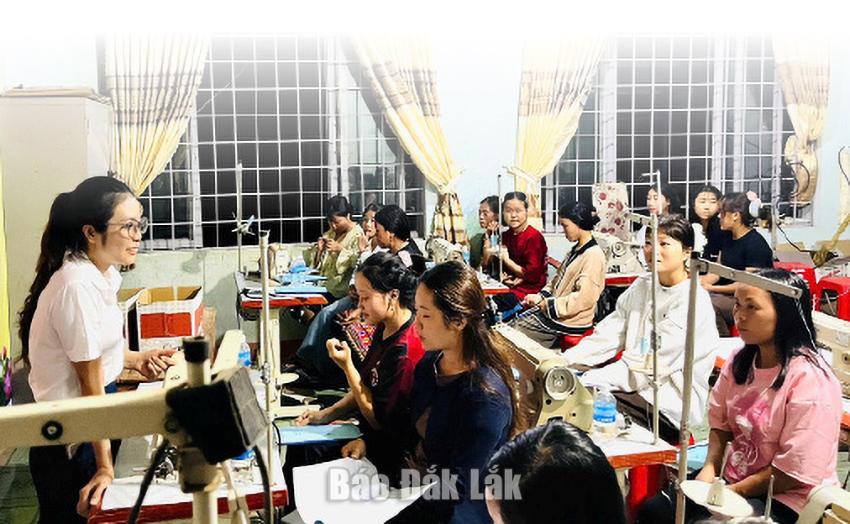 |
| Workers in Ea Trang Commune receiving free sewing training to gain additional employment opportunities. |
In Ea Trang, the commune People's Committee, in coordination with the M’Drak Centre for Vocational Education and Continuing Education, organised a free sewing course, providing meal as well as travel allowances for 35 people from poor and near-poor households along with ethnic minority communities.
According to Mr. Vang Seo Pua, Head of Ea Bra hamlet, holding the classes at the hamlet's community hall in the evenings makes it easier for local residents to attend. After working hours, they can learn an additional trade and accumulate knowledge, giving them greater opportunities to find employment or develop their household economy.
Creating livelihoods for greater self-reliance
Dak Lak aims to reduce the poverty rate from 4.13% at the end of 2025 to 2.13% by the end of 2026 under the 2022 - 2025 multidimensional poverty standard. The province also aims for every poor and near-poor household to have at least one working-age member with regular, stable employment together with an appropriate income.
To make poverty reduction efforts effective, alongside direct support policies, coordinated participation is needed from all levels, sectors, mass organisations and the wider community. Mr. Nguyen Duc Thang, Head of the provincial Sub-Department of Rural Development, said: “The Sub-Department is coordinating with agencies and mass organisations to strengthen communications as well as raise awareness of the importance and shared responsibility for multidimensional poverty reduction along with sustainable job creation, thereby encouraging people and communities to proactively work their way out of poverty; ensuring that the programme reaches the right beneficiaries, achieves its intended objectives as well as is implemented effectively and sustainably.”
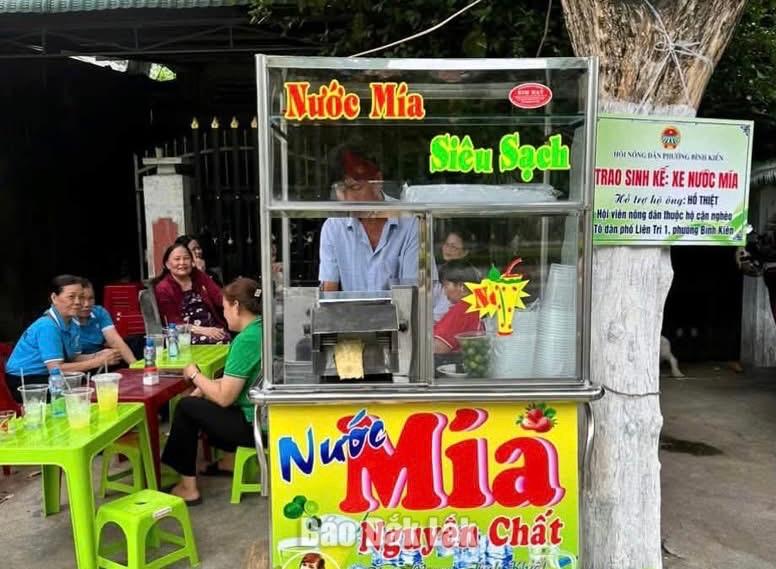 |
| The Binh Kien Ward Farmers' Association presenting a sugarcane juice cart to Mr. Ho Thiet's household as a means of livelihood. |
Simultaneously, the province is focusing on creating conditions that enable people to become more self-reliant in their daily lives. It will maximise and effectively utilise resources from the National Target Programme for 2026 - 2030, integrating them with other programmes, projects combined with lawful resources to achieve multidimensional, inclusive and sustainable poverty reduction.
In particular, the province will focus on effectively implementing policy credit programmes for poor and near-poor households and other eligible groups; supporting production development, livelihood diversification, vocational training and job creation to increase incomes among poor and near-poor households with working-age members. Vocational training for rural workers will be aligned with the needs of enterprises, cooperatives and the labour market. Labour supply alongside demand will be increasingly connected through job fairs, employment counselling and placement services; workers will be supported in accessing labour market information, employment policies, as well as sources of loans for job creation.
Translated by KHUONG THAO