Province-wide digital transformation (DX) implementation continues to face considerable challenges in infrastructure, human resources and digital skills. Identifying along with focusing resources on addressing bottlenecks is now an urgent requirement to ensure DX delivers tangible benefits to residents and enterprises.
 |
| Cuor Dang Commune Police guiding residents in using VNeID application services. |
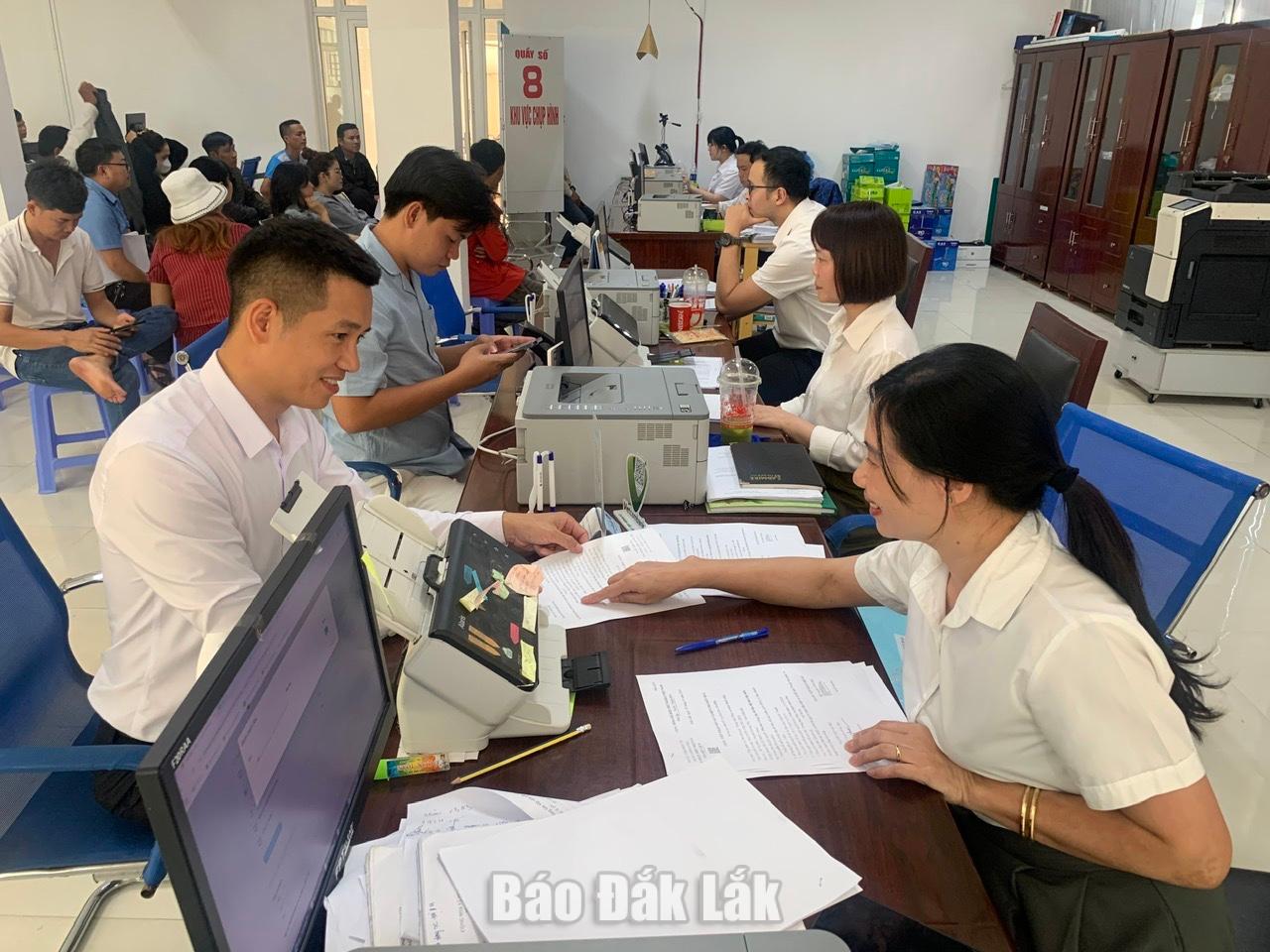
At the Ea M’droh Commune Public Administration Service Centre, receiving and handling online applications has become routine. During the first 10 months of 2026, the centre received as well as processed more than 5,800 applications. All application components were digitised, while the digitisation rate of processing outcomes reached nearly 97%. However, implementation still faces difficulties due to the commune’s large geographical area, scattered population distribution and limited access to technology among certain groups of residents. In addition, management systems together with public service portals operated by ministries, sectors and local authorities remain insufficiently synchronised, with occasional technical glitches. Information technology (IT) infrastructure also remains inadequate to meet requirements.
According to comrade Bui Thanh Toan, Member of the Provincial Party Standing Committee and Director of the Department of Science and Technology (S&T), IT infrastructure, human resources combined with the habit of using technology adoption in everyday life are the three major bottlenecks requiring priority attention. Digital infrastructure coupled with equipment serving DX remain inadequate, particularly in remote and disadvantaged areas. The province also lacks highly qualified IT personnel. Notably, some residents have yet to develop the habit of using technology in their daily activities, education, production together with business.
Ensuring DX delivers deeper results
From July 10 to November 30, 2026, the province is rolling out a 100-day campaign to address DX bottlenecks. The campaign focuses on reviewing procedures and reducing manual operations, paperwork, processing time as well as costs for residents and enterprises, while clearly defining responsibilities and deadlines for addressing each issue. Problems falling within local authorities’ jurisdiction must be resolved immediately, while shortcomings involving shared systems, data connectivity and inter-agency procedures must be consolidated alongside submitted for coordinated resolution.
The province is focusing on building a long-term foundation for the development of digital government, the digital economy and digital society. It has issued five plans to implement Politburo Resolution No. 57-NQ/TW, comprising 131 specific tasks in accordance with the “six clarities” principle. It has also identified eight major tasks in S&T, innovation combined with DX for the 2026 - 2030 period. In addition, the province has issued a framework for digital architecture, governance and management, providing a basis for connecting, integrating, sharing while exploiting data province-wide.
 |
| Women in Ea Tul Commune learning how to market agricultural products on digital platforms. |
Simultaneously, the “Digital Literacy for All” movement is being widely implemented. Community-based digital technology teams, Youth Union members and young people are directly guiding residents in accessing digital services coupled with utilities, including VNeID, online public services and cashless payments.
The province is also working to develop DX models with tangible outputs, measurable criteria and potential for wider replication. Four pilot models were launched in September 2026: “Outstanding Digital Citizen”, “Outstanding Digital Village/Hamlet/Residential Area”, “Digital Rural Areas - Building Prosperity through Technology” and “Digital Villages/Hamlets in Ethnic Minority Areas”.
Comrade Bui Thanh Toan, Director of the Department of S&T, said that addressing bottlenecks to achieve substantive progress and deeper DX requires coordination across the entire political system, enterprises along with residents. The effectiveness of DX must be measured by tangible improvements in people's lives: residents can complete administrative procedures more conveniently, enterprises can reduce costs, and agricultural products gain greater opportunities to access markets. Only when technology addresses real-world challenges can DX become a growth driver, enabling the province to develop rapidly as well as sustainably.
Translated by KHUONG THAO