After eight years implementing Resolution 36-NQ/TW, dated October 22, 2018, issued by the Party Central Committee (12th tenure) on the strategy for the sustainable development of Vietnam’s marine economy to 2030, with a vision toward 2045, the marine economy of Dak Lak province has recorded clear progress, gradually affirming its role as one of the key growth pillars.
Policy-driven momentum
Implementation of Resolution 36 has been carried out in a coordinated manner from the provincial to grassroots levels. Action programmes and implementation plans have been issued promptly, aligned with local conditions. On that basis, key marine economic sectors have recorded notable growth. Coastal and island tourism has expanded rapidly, with visitor numbers reaching approximately 20 million in the 2021 - 2025 period.
 |
| Workers sorting and processing ocean tuna under a closed production process for export at an enterprise in the South Phu Yen Economic Zone. |
Simultaneously, the fisheries sector continues playing an important role, with more than 2,500 fishing vessels and stable annual catches of roughly 68,000 tonnes, ensuring livelihoods for tens of thousands of workers. The sector is shifting from nearshore to offshore fishing alongside from small-scale aquaculture to industrial marine farming.
Notably, the development mindset has shifted from “exploitation” to “exploitation associated with protection and sustainable development”. The management of marine resources together with environmental protection has been strengthened through integrated coastal zone management. A range of surveys alongside marine and island database development has been carried out, contributing to stabilisation of coastal environments while laying foundation for tourism as well as related sectors.
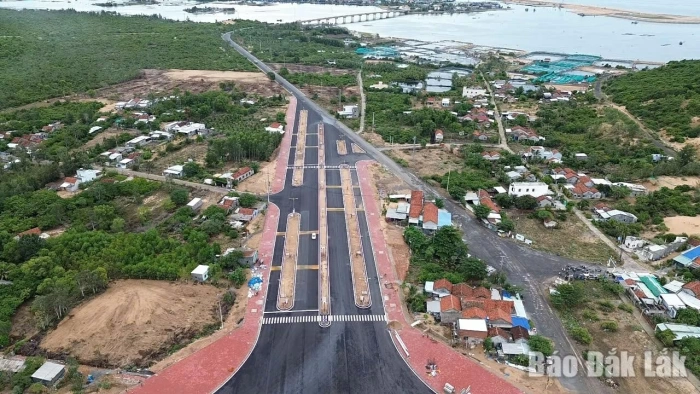
Moreover, the South Phu Yen Economic Zone (EZ) has gradually promoted its role as a driving force for development, attracting investment in industry, energy and logistics. Transport infrastructure along with seaports have received increased investment, enhancing connectivity and expanding development space.
Unlocking new growth momentum
Resolution 36 has established an important foundation for marine economic development in Dak Lak. However, these outcomes remain modest and have yet to match the provincial potential as well as development requirements, calling for more coordinated, long-term and breakthrough solutions.
Comrade Huynh Lu Tan, Member of the Provincial Party Standing Committee and Head of Phu Yen EZ Management Board, stated that so far, the South Phu Yen EZ together with industrial parks (IPs) have attracted 130 projects with total registered land area exceeding 1,454 ha. In the coming period, the focus will be on expanding the EZ and IPs to serve as growth drivers, prioritising infrastructure completion, particularly highly connected interregional transport projects, seaport systems associated with Bai Goc deep-water port, and resettlement areas serving development.
 |
| Dak Lak transitioning from small-scale aquaculture to industrial marine farming. |
According to the Department of Agriculture and Environment, the sector will complete marine spatial planning, accelerate digital transformation in resource and environmental management, along with developing high-tech marine aquaculture, offshore renewable energy and high-quality marine tourism, aiming for sustainable growth in harmony with ecosystem protection. Renewable energy alongside green economy are identified as strategic directions, effectively harnessing wind and solar potential together with gradually forming offshore wind and solar power centres.
Comrade Nguyen Thien Van, PPC Vice Chairman, stated that redefining marine space is both an urgent requirement in the current context and an opportunity for breakthrough development. Dak Lak will implement Resolution 36 in a coordinated as well as decisive manner; strengthen leadership, improve institutions and planning, enhance the investment environment, remove procedural bottlenecks, and establish competitive incentive mechanisms to attract resources. The province will prioritise investment in modern, synchronized infrastructure, particularly integrated transport connectivity, seaports alongside logistics; promote science, technology and innovation, while developing key sectors including fisheries and tourism.
Translated by KHUONG THAO