The Viet Nam-EFTA Free Trade Agreement is expected to open up new avenues for cooperation and provide fresh impetus for economic growth, innovation and sustainable development, delivering tangible benefits to people and businesses in Viet Nam and EFTA member states.
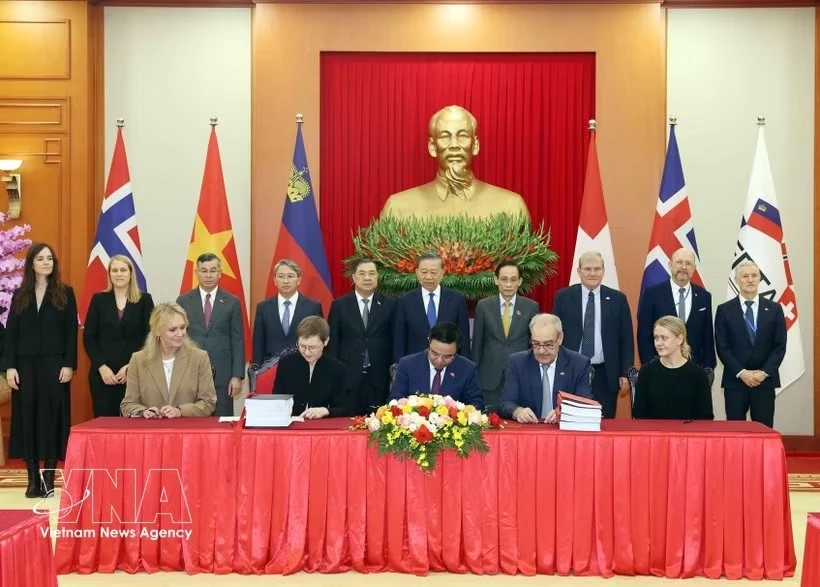 |
| Representatives of Viet Nam and the member states of the European Free Trade Association (EFTA) officially sign the Viet Nam-EFTA Free Trade Agreement (VEFTA) in Ha Noi on October 18 (Photo: VNA) |
Viet Nam's Minister of Industry and Trade Le Manh Hung and representatives of the member states of the European Free Trade Association (EFTA) officially signed the Viet Nam-EFTA Free Trade Agreement (VEFTA) in Hanoi on October 18.
The signing was witnessed by General Secretary of the Communist Party of Viet Nam Central Committee and President To Lam.
The EFTA representatives were Swiss President and head of Swiss Department of Economic Affairs, Education and Research Guy Parmelin; Liechtenstein Prime Minister and Minister of Government Affairs and Finance Brigitte Haas; Iceland's Minister for Foreign Affairs Þorgerður Katrín Gunnarsdóttir; and Norwegian State Secretary at the Ministry of Foreign Affairs Astrid Bergmål.
The signing marks an important milestone in relations between Viet Nam and EFTA, which comprise some of the world’s leaders in innovation.
It also reflects both sides’ determination to strengthen economic cooperation, promote free trade and reinforce the rules-based trading system amid continued global economic uncertainty.
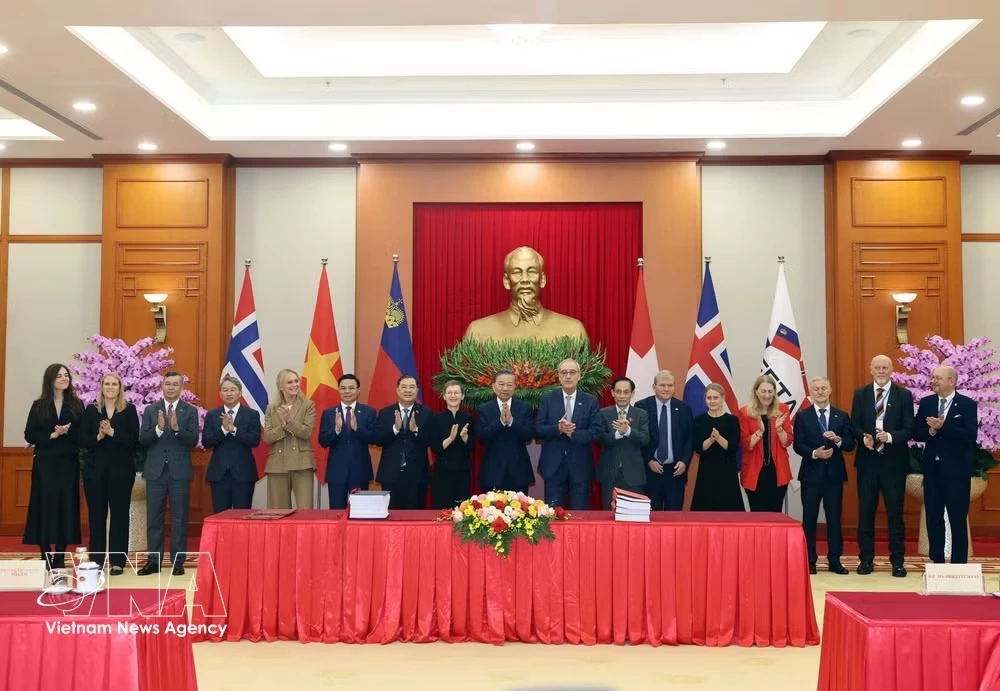 |
| General Secretary of the Communist Party of Viet Nam Central Committee and President To Lam (middle) and delegates at the signing ceremony (Photo: VNA) |
The comprehensive agreement covers a wide range of key areas, including trade in goods, encompassing tariffs, technical barriers to trade, sanitary and phytosanitary measures, customs and trade remedies; trade in services; investment; intellectual property; government procurement; competition; small and medium-sized enterprises; dispute settlement; and trade and sustainable development.
With its broad scope and diverse areas of cooperation, the deal is expected to create new opportunities for Viet Nam to diversify its export and import markets, enhance business competitiveness and participate more deeply in global value chains. It is also expected to attract high-quality investment, advanced technologies and management expertise from leading European economies.
Economic, trade and investment ties between Viet Nam and EFTA member states have continued to grow positively, with bilateral trade averaging nearly 2 billion USD annually. The two sides have highly complementary trade structures, reflecting their respective strengths and needs.
Viet Nam’s main exports to EFTA markets include seafood, footwear, textiles and garments, machinery and equipment, electronics and components. Imports from EFTA mainly comprise machinery, industrial equipment, chemicals, pharmaceuticals and production materials.
Investment cooperation has also expanded. As of the end of 2025, Switzerland had 234 investment projects in Viet Nam with total registered capital exceeding 2.4 billion USD, while Norway had 62 projects worth more than 201 million USD.
Many major EFTA corporations and investors have established a presence in Viet Nam and operated successfully in industries such as manufacturing, food, pharmaceuticals, energy and technology. EFTA businesses and investors are also planning major projects in Viet Nam in areas including innovation, high technology, logistics and precision engineering.
The Viet Nam-EFTA Free Trade Agreement is expected to open up new avenues for cooperation and provide fresh impetus for economic growth, innovation and sustainable development, delivering tangible benefits to people and businesses in Viet Nam and EFTA member states.
VNA