A report jointly released by US global management consulting firm Bain & Company, Singaporean financial services group DBS and Singapore-based strategic consultancy Vriens & Partners said Vietnam remained a leading growth market in Southeast Asia, with baseline growth projected at 6.2%.
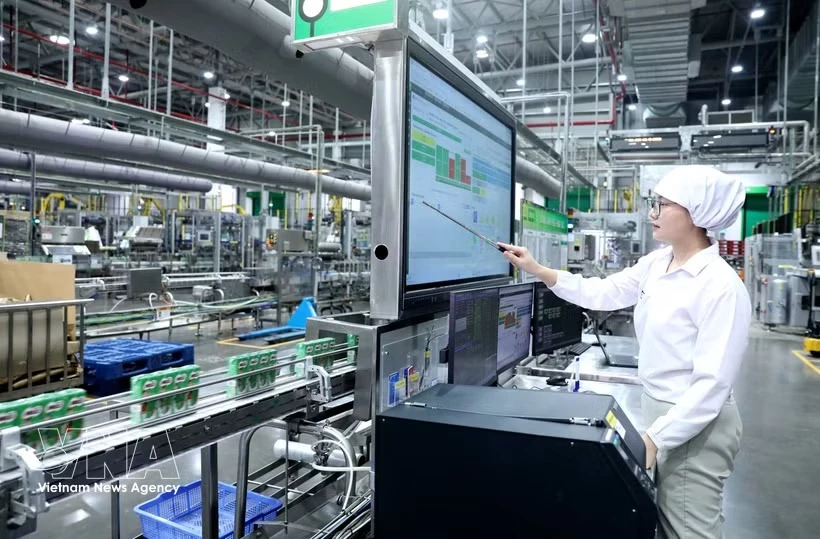 |
| Nestlé Viet Nam is a Swiss-invested enterprise that has continuously increased its investment and expanded operations in Hung Yen province since 2017. (Photo: VNA) |
In September, major international media outlets and financial institutions offered positive assessments of Viet Nam’s economic outlook, describing the country as a growth bright spot in Southeast Asia while highlighting notable developments in its financial market and fresh growth momentum from technological transformation.
Solid growth foundation
Reuters, Bloomberg and the World Bank (WB) continued to highlight Viet Nam’s strong economic performance in the region. According to WB data, the country’s GDP surged from 16.24 billion USD in 1994 to 514.7 billion USD.
Notably, measured by purchasing power parity, the Vietnamese economy has surpassed 1 trillion USD, providing a solid foundation for its goal of becoming a developed nation by 2045.
A report jointly released by US global management consulting firm Bain & Company, Singaporean financial services group DBS and Singapore-based strategic consultancy Vriens & Partners said Viet Nam remained a leading growth market in Southeast Asia, with baseline growth projected at 6.2%.
Growth has been driven by its increasingly important role in global supply chains, as the country has become a key manufacturing link for multinational corporations such as Samsung, Intel and Foxconn. Foreign-invested enterprises currently account for around 70% of Viet Nam’s total export turnover.
A notable milestone in September was the official inclusion of the Vietnamese stock market among secondary emerging markets by UK index provider FTSE Russell.
According to FTSE Russell, the move could help Viet Nam attract around 6 billion USD in foreign capital. US asset manager Vanguard also announced plans to increase its investment in Viet Nam to 2.5 billion USD, reflecting growing international investor interest in the Vietnamese market.
Embracing technology wave
Domestic manufacturing has also shown a strong recovery. According to the S&P Global Manufacturing Purchasing Managers’ Index (PMI), the PMI of Viet Nam's manufacturing sector stood at 53.3 in August 2026, marking the 14th consecutive month above the 50-point threshold and the strongest improvement since the beginning of the year.
Commenting on the recovery, S&P Global noted that a key strength of Viet Nam’s manufacturing sector is businesses’ ability to optimise operational efficiency. Despite global geopolitical uncertainties, companies have proactively cut costs and reduced excess labour to focus on boosting core output. This approach helped production expand at its fastest pace in more than two years.
Meanwhile, the rapid development of artificial intelligence (AI) and automation is reshaping Viet Nam’s labour market. A survey by Japan’s Reeracoen Group and Rakuten Insight showed that among six surveyed ASEAN markets, Viet Nam recorded the highest proportion of businesses reporting improved revenue, at 46%, as well as the highest rate of companies expanding recruitment, at 16%. Business confidence also remained relatively positive, with 59% of executives optimistic about their business prospects.
According to Malaysia-based HR Asia, Viet Nam is the only Southeast Asian market where AI and automation rank as the leading factor prompting workers to change careers, cited by 39% of respondents.
The trend highlights the increasingly visible impact of technology on career choices in Viet Nam and underscores the need for workers to adapt and upgrade their skills as the labour market undergoes rapid transformation.
VNA